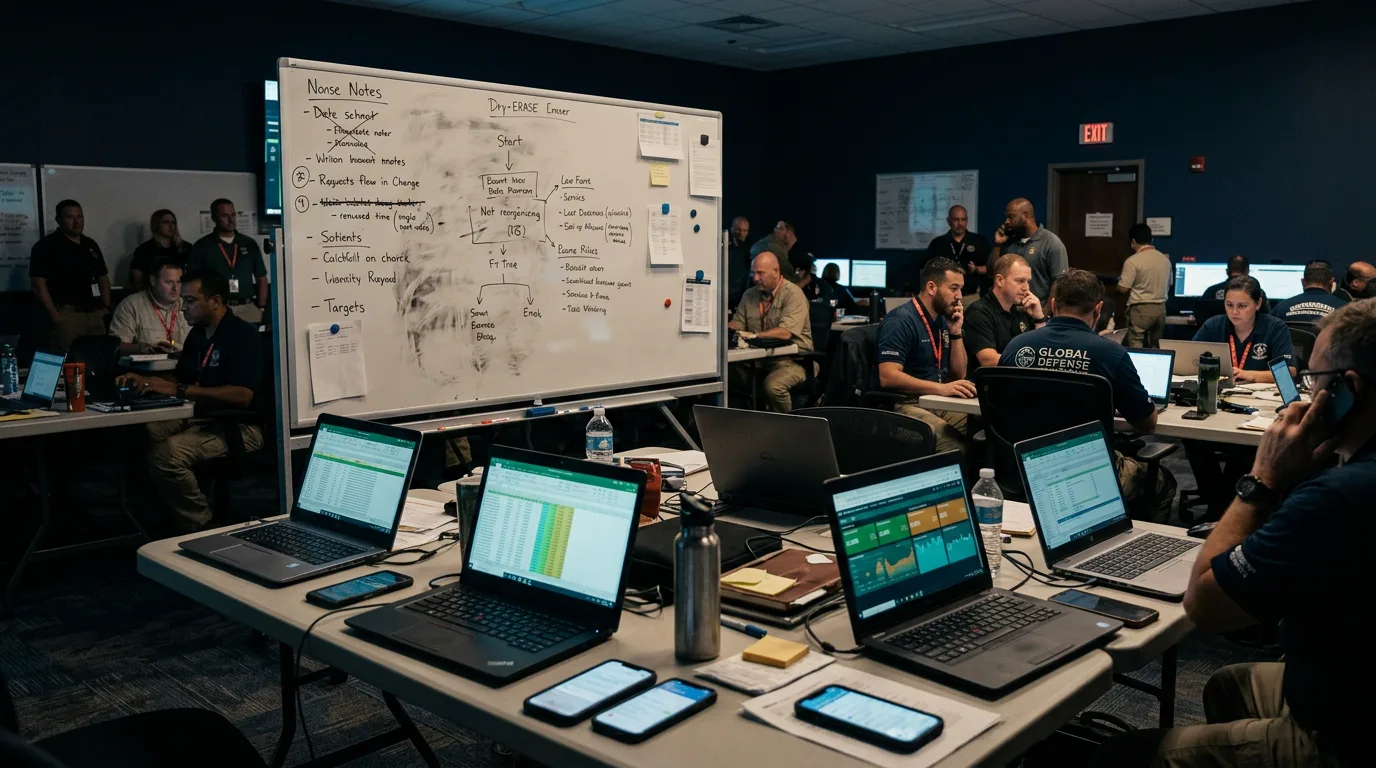

The EOC Battle Rhythm: Your EOC Should Not Be Running the Incident’s Clock
September 1, 2026
FEMA doctrine lets the EOC run a different operational period than the incident. Here is how to set that clock, hold it, and keep the two synchronized.
All posts tagged with "emergency management".

September 1, 2026
FEMA doctrine lets the EOC run a different operational period than the incident. Here is how to set that clock, hold it, and keep the two synchronized.

August 22, 2026
Three levels, one real decision. What triggers each activation level, who holds authority to call it, and the staffing promise most jurisdictions cannot keep.

August 16, 2026
Both are NIMS. But NIMS names three EOC structures, and the same section titles do different work on either side. Here is what actually differs.

August 7, 2026
An EOC is accountable for products, not presence. The four deliverables every activation owes, who consumes each one, and the cadence they are due on.

July 3, 2026
The EOC tech stack in the plan is not the one in the room. A look at the tools coordination actually runs on — and the exact load at which each one fails.

June 6, 2026
NIMS has three components — Resource Management, Command and Coordination, and Communications and Information Management. Here is what each one does.

April 9, 2026
DHS Secretary Mullin says states should lead disaster response. Here is what FEMA's shift means for local emergency managers — and what to do now.

April 2, 2026
Multi-agency coordination is not one system — under NIMS, it is the umbrella for ICS, EOCs, MAC Groups, and JIS. Here is what the doctrine actually says.

March 27, 2026
Paper-based ICS processes cost agencies millions in lost FEMA reimbursements. Modern emergency management software is transforming cost recovery.

March 13, 2026
Dashboards are not situational awareness. Learn why most EOCs mistake data display for actionable intelligence during multi-agency incident response.

March 6, 2026
NIMS is the national framework. ICS is the on-scene command system inside it. Most practitioners conflate the two — here is what actually distinguishes them and why it matters.
See how NIMS Logic transforms incident management from administrative burden to operational advantage. Real-time visibility. Automated workflows. Complete accountability.