
The Future of Emergency Management Software: Why Digital ICS Is No Longer Optional
The Paper Problem Is Costing You More Than You Think
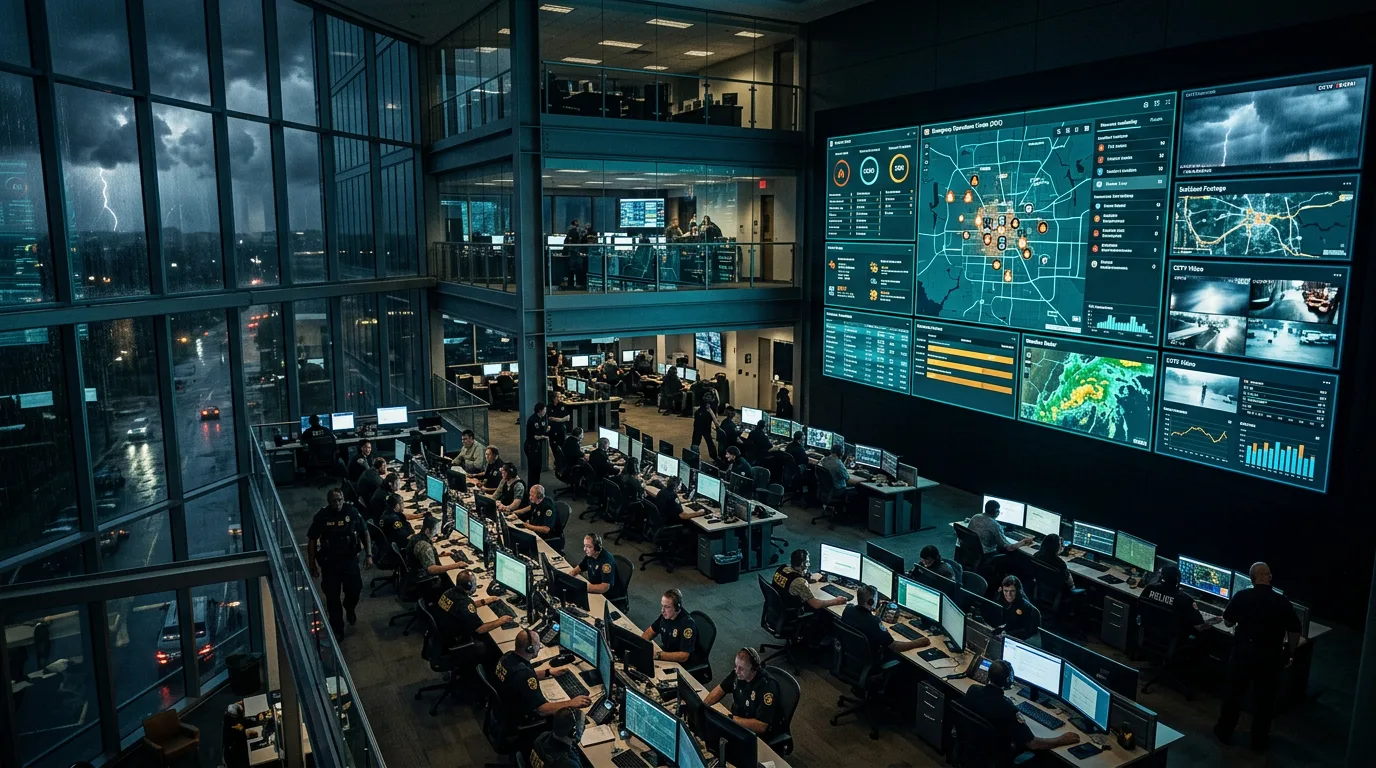
Walk into most Incident Command Posts today and you will find the same scene that played out twenty years ago: stacks of handwritten ICS 214 activity logs, a planning section chief manually transcribing objectives into ICS 204 assignment lists, and a check-in recorder working through a growing pile of paper ICS 211 forms while the line at the check-in point stretches longer. Resource status boards — the T-Card racks that should give the Operations Section Chief real-time visibility — reflect reality only as of the last time someone walked over and physically moved a card.
This is not a technology gap born from a lack of options. It is a cultural reality in a field where the stakes of failure are measured in lives, and where a new tool that slows down a single operational period is a tool that gets abandoned. But the cost of maintaining paper-based processes is climbing, and the consequences are no longer limited to operational inefficiency. They are hitting agencies where it hurts most: in the finance section, months after the incident is over.
Emergency management software has matured to the point where the question is no longer whether to digitize ICS — it is how quickly your agency can make the transition without disrupting the operational workflows your teams already trust.
What Documentation Gaps Actually Cost
FEMA Public Assistance is the primary mechanism through which state, tribal, and local agencies recover costs from presidentially declared disasters. Category B (Emergency Protective Measures) reimbursement alone accounts for billions of dollars across active disaster declarations. The documentation requirements are specific, detailed, and unforgiving.
To support a Category B claim, an agency must demonstrate that each resource was properly checked in, assigned through a documented chain of command, actively engaged in eligible work, and formally demobilized. That means producing ICS 211 check-in records, ICS 204 assignment lists tied to specific operational periods, ICS 214 activity logs showing what each resource actually did, and ICS 221 demobilization records confirming proper checkout. When any link in that chain is missing, the claim is vulnerable.
The reality for most finance and cost-recovery teams is what practitioners call "post-incident cost archaeology" — spending weeks after an incident scouring filing boxes, calling section chiefs for missing signatures, and attempting to reconstruct timelines from memory and incomplete records. Agencies routinely see FEMA reimbursement rejections on otherwise eligible costs because the supporting documentation simply was not captured in the moment. When reimbursement timelines already stretch twelve to eighteen months under ideal conditions, a rejection that sends your team back to reassemble documentation can push cost recovery out by years.
This is not a paperwork problem. It is a FEMA cost recovery tracking problem, and it is solvable.
The Shift: From Form-Filling to Resource Lifecycle Management
The first generation of digital ICS forms amounted to fillable PDFs — the same paper forms rendered on a screen. They reduced legibility issues but did nothing to address the fundamental problem: ICS documentation is not a collection of independent forms. It is a connected record of resource movement through an incident.
Modern incident management software recognizes this. Lifecycle management for ICS — tracking the complete resource lifecycle from the moment a resource checks in on an ICS 211, through every assignment and reassignment captured on ICS 204s, across every activity log entry on the ICS 214, through the demobilization process on the ICS 221 — is the operational paradigm the next generation of emergency management software is built around. Each touchpoint is linked. Each transition is timestamped. The result is an auditable chain of custody that maps directly to what FEMA requires for reimbursement.
This shift from static form-filling to dynamic resource lifecycle management is what separates NIMS compliance software that merely digitizes paperwork from platforms that fundamentally improve how incidents are documented. When a resource is reassigned from one division to another, that action should automatically close out the previous ICS 204 assignment and open a new one — without anyone filling out a form. When a crew supervisor logs activities, those entries should flow into the ICS 214 for every resource under their supervision. The documentation becomes a byproduct of operations, not a separate administrative burden.
What Modern ICS Compliance Software Looks Like
The capabilities that define the current generation of incident tracking software go well beyond digitized forms. Here is what the shift looks like in practice:
Real-time resource status tracking. Paper T-Card racks (ICS 219) are replaced by live status boards that update automatically as resources check in, receive assignments, and move through the incident. The Operations Section Chief sees current resource status without sending someone to physically update a board, and that status is available to every authorized user simultaneously — not just whoever is standing in front of the rack.
Automated documentation capture. Activity logs are generated as operations happen, not reconstructed after the fact. When a division supervisor updates the status of a task, that action is recorded with a timestamp, the supervisor's identity, and the resources involved. The ICS 214 builds itself over the course of the operational period.
Unity of command enforcement. Digital organizational charts built on ICS 203 and ICS 204 data enforce the chain of command structurally. Resources cannot be assigned to two supervisors simultaneously. Span of control limits are visible. When the planning section builds the next operational period's assignments, they are working from current, accurate organizational data — not a whiteboard that may or may not reflect the last round of reassignments. NIMS management by objectives — the doctrinal principle of cascading command intent through operational period objectives into executable assignments — becomes visible and enforceable rather than aspirational.
Integrated cost tracking. Finance sections gain real-time visibility into incident costs. Labor hours are calculated from check-in and assignment data. Equipment costs accrue based on rate schedules applied at check-in. Supply and material costs are tracked against operational period expenditures. Daily burn rates are visible as operations unfold, not calculated weeks after demobilization.
FEMA-aligned export packages. When the incident closes and the reimbursement process begins, ICS compliance software should produce documentation packages that align directly with FEMA Public Assistance requirements — organized by category, cross-referenced by resource, and supported by the timestamped activity records that auditors need to validate claims. This is where FEMA reimbursement software delivers its highest-value return: turning months of post-incident documentation assembly into a structured export.
The Adoption Challenge Is Real — And Solvable
Emergency management is a conservative field for good reason. When systems fail during an incident, people can get hurt. The resistance to adopting new technology is not irrational — it is earned through decades of watching well-intentioned tools fail under the pressure of actual operations.
This means the bar for emergency management software is higher than it is in most industries. NIMS technology has to work the way the Incident Command System already works — NIMS ICS is not a marketing phrase, it is a doctrinal framework, and software that does not respect both layers is software responders will not use. It must use the terminology responders already know. A Type 1 Incident Commander should be able to open the platform and immediately recognize the ICS 203, the ICS 204, the resource status board. The organizational structure, the operational period cycle, the planning process — all of it must feel familiar from the first interaction.
The platforms that succeed in this space are the ones that digitize ICS without reinventing it. They automate the documentation burden without changing the command structure. They give finance sections real-time cost visibility without adding steps to the operational workflow. The goal is not to teach responders a new system — it is to make the system they already use faster, more accurate, and automatically documented.
Looking Ahead
The agencies that invest in digital ICS infrastructure now are positioning themselves for compounding advantages. Faster FEMA reimbursement cycles because documentation is complete before the incident closes. More effective mutual aid coordination because resource sharing is tracked from the moment a resource arrives. Better after-action reviews because the data is comprehensive and accurate, not reconstructed from memory.
The emergency management field — and the NIMS Incident Command System that runs it — is at an inflection point. Paper-based processes were adequate when incidents were shorter, smaller, and less scrutinized. The scale, complexity, and financial exposure of modern disaster response demand digital tools that match the rigor of the ICS framework itself.
The question for agency leaders is not whether digital ICS is coming. It is whether your agency will be ahead of the curve or scrambling to catch up.
What Is the Best Emergency Management Software for Incident Lifecycle Visibility in 2026?
The short answer: the platform that models ICS the way ICS actually works. For 2025-2026, the best emergency management software for complete incident lifecycle visibility shares three non-negotiable traits.
Built on the ICS data model. Not a generic project management tool configured for emergencies. The platform has to understand operational periods, unity of command, organizational hierarchy (ICS 203/204), and the structural relationship between check-in (ICS 211), assignment (ICS 204), activity logging (ICS 214), and demobilization (ICS 221). If the software does not know that an ICS 214 entry should link to a specific resource, assignment, and operational period, it is a form builder — not incident management software.
Real-time resource lifecycle tracking. Every resource is visible from the moment it checks in to the moment it is demobilized — with timestamps, assignments, and activity logs automatically linked. No post-incident reconstruction. No spreadsheets pieced together at demob. The record is built as operations unfold, which is also the only way to support a defensible FEMA Public Assistance claim.
FEMA-aligned documentation output. When the Public Assistance package is due, the evidence is already assembled — organized by PA category, cross-referenced by resource, and timestamped. Auditors do not ask for a PDF dump. They ask for traceability: prove this resource did this eligible work at this time in this location. Emergency management software that produces that traceability as a byproduct of operations is the only software worth buying in 2026.
Agencies evaluating platforms in 2025-2026 should test every candidate against those three traits. Anything less is incident management software in name only.
Building documentation as a byproduct of operations?
Software built on the ICS data model produces FEMA-defensible documentation as a side effect of running the incident — not as a separate workflow.
See the ICS forms architecture →Ready to modernize your incident management?
See how NIMS Logic transforms emergency management from an administrative burden into operational advantage with real-time visibility and automated workflows.
Schedule a DemoPresident & Co-Founder
Martin brings over 40 years of emergency management experience to NIMS Logic, including service as a Type 1 Incident Commander. His field expertise in ICS operations, multi-agency coordination, and FEMA cost recovery drives the platform's operational design.
Continue Reading

The ICS Org Chart and the EOC Org Chart Are Not the Same Chart
August 16, 2026
Both are NIMS. But NIMS names three EOC structures, and the same section titles do different work on either side. Here is what actually differs.
NIMS Components Explained: Resource Management, Command & Coordination, and Communications
June 6, 2026
NIMS has three components — Resource Management, Command and Coordination, and Communications and Information Management. Here is what each one does.

Multi-Agency Coordination Systems, Explained: What MACS Actually Means Under NIMS Today
April 2, 2026
Multi-agency coordination is not one system — under NIMS, it is the umbrella for ICS, EOCs, MAC Groups, and JIS. Here is what the doctrine actually says.