
What an EOC Actually Produces: The SitRep, the Action Plan, and the Situation Picture
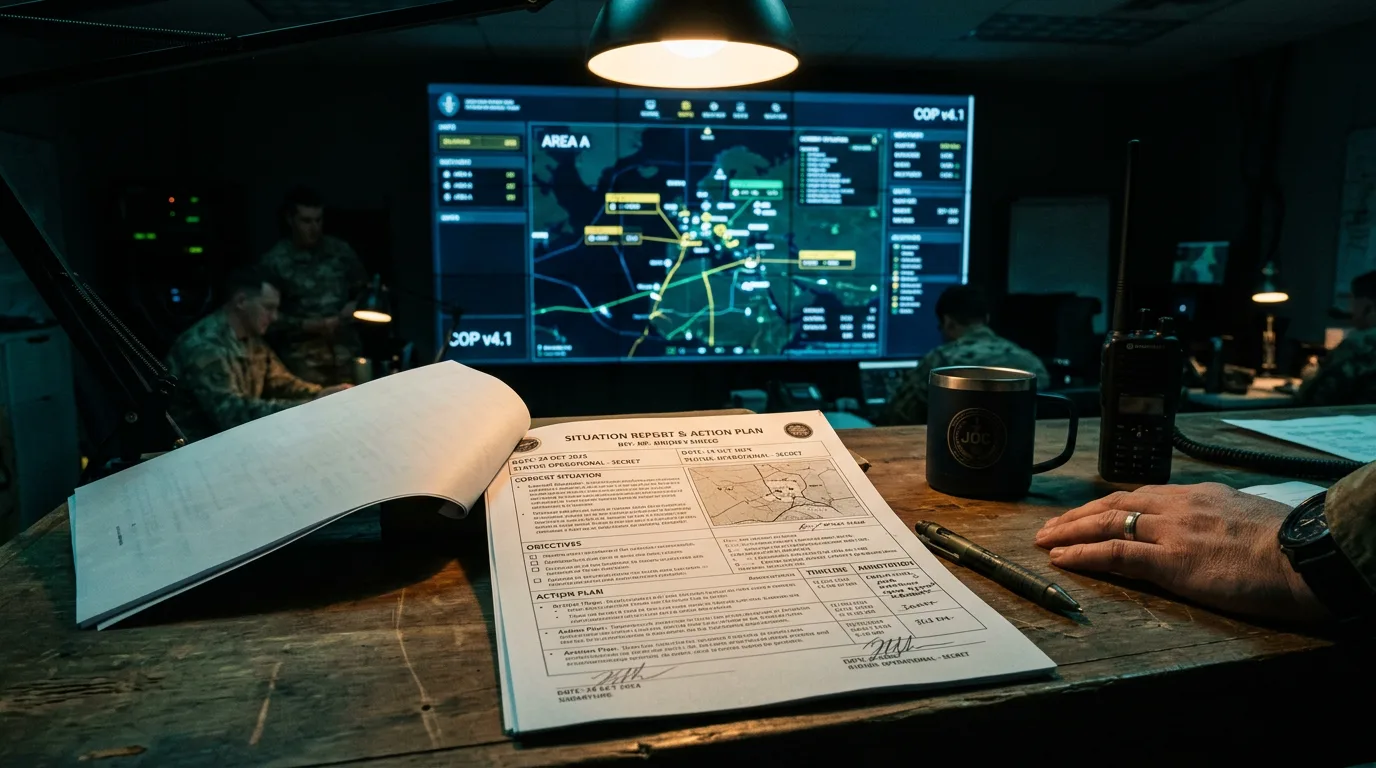
An EOC is not accountable for being staffed. It is accountable for products.
That distinction gets lost during activations, because presence is visible and products are not. A room full of people at 0300 looks like a functioning EOC. Whether it produced anything a decision-maker could use is a separate question, and it is the only one that matters after the incident.
Four deliverables carry the load. Each has a consumer, a cadence, and a failure mode.
1. The Activation Notification and the Initial SitRep
The first product is the one that says the EOC is open. Doctrine is specific here: the initial situation report should follow the activation alert as a fast follow-up carrying the incident details.
This pairing matters. The notification tells partner agencies to lean in. The initial SitRep tells them what they are leaning into. An activation notice sent without a SitRep behind it generates a wave of inbound calls asking what is happening — which is the EOC's own first self-inflicted resource drain.
2. The SitRep Answers Questions Somebody Asked in Advance
The SitRep is the EOC's recurring product. Its purpose is to ensure every party involved in the response is informed of the current state of the operation.
Most SitReps fail for a structural reason: they report what the drafter knew at the deadline rather than what the consumer needs to decide. The fix is Essential Elements of Information — EEIs are written out ahead of time, as questions, by the people who will consume the answers.
That inversion changes the document entirely. Instead of "here is what we know," the SitRep becomes "here are the answers to the eleven questions you told us you would ask." Unanswered EEIs become visible gaps rather than silent ones — and a known gap is actionable in a way that an unmentioned one never is.
Write the EEIs before the season. Writing them during an activation means guessing at your own consumers.
3. The EOC Action Plan Is Not an IAP
This is the deliverable most often skipped, usually because the EOC assumes the incident's IAP covers it. It does not.
The Incident Command Post runs the Planning P and produces an Incident Action Plan that tasks responders for one incident's operational period. The EOC produces an EOC Action Plan on its own cycle, and it tasks something different: the support effort. Resource allocation priorities across competing demands. Coordination objectives. Information requirements. Which incident gets the last available strike team.
The clearest way to hold the line: if the product tells a responder what to do at a location, it belongs in an IAP. If it tells the coordination effort what to prioritize, it belongs in the EOC Action Plan. A jurisdiction supporting three simultaneous incidents has three IAPs and one EOC Action Plan — and only that last document reconciles them.
4. The Situation Picture Is a Deliverable, Not a Screen
The common operating picture gets treated as infrastructure — a display that exists. Treat it as a product with a consumer and a due time instead.
The test is not whether the picture is on the wall. It is whether a decision-maker walking in cold can read it and act without a briefing. If the display requires a person standing next to it interpreting, the picture is not the deliverable. The person is — and that person cannot be in two places or awake for thirty hours.
Resource Request Status Is the Fifth Product
Formally it is part of planning and resource support. Practically it is its own deliverable, because it has its own consumer: the requester.
EOC resource tracking runs from initial request through fill, handoff to incident command, and demobilization for anything that stays under EOC management. At every stage the requester needs status, estimated time of arrival, and the logistics around it. When that information only exists inside the EOC, the requester has to call to get it — and the EOC spends its coordination capacity answering questions its own records should have already answered.
The Test
At the end of any activation, ask what the EOC produced and whether each product was on time. If the honest answer is that the EOC was busy, coordinated a great deal, and generated nothing an auditor, a successor shift, or an elected official could read afterward, then the activation happened but the EOC's work did not survive it.
Products on a cadence are what separate a staffed room from a functioning operations center. Everything else is presence.
See how NIMS Logic turns EOC coordination into products that build themselves. Explore the platform.
Ready to modernize your incident management?
See how NIMS Logic transforms emergency management from an administrative burden into operational advantage with real-time visibility and automated workflows.
Schedule a DemoEditorial Team
The NIMS Logic team combines decades of emergency management field experience with modern software engineering to build the incident management platform the industry has needed.
Continue Reading
The EOC Battle Rhythm: Your EOC Should Not Be Running the Incident’s Clock
September 1, 2026
FEMA doctrine lets the EOC run a different operational period than the incident. Here is how to set that clock, hold it, and keep the two synchronized.

EOC Activation Levels: What Actually Changes When You Go to Level 2
August 22, 2026
Three levels, one real decision. What triggers each activation level, who holds authority to call it, and the staffing promise most jurisdictions cannot keep.

The ICS Org Chart and the EOC Org Chart Are Not the Same Chart
August 16, 2026
Both are NIMS. But NIMS names three EOC structures, and the same section titles do different work on either side. Here is what actually differs.