
Multi-Agency Coordination Systems, Explained: What MACS Actually Means Under NIMS Today
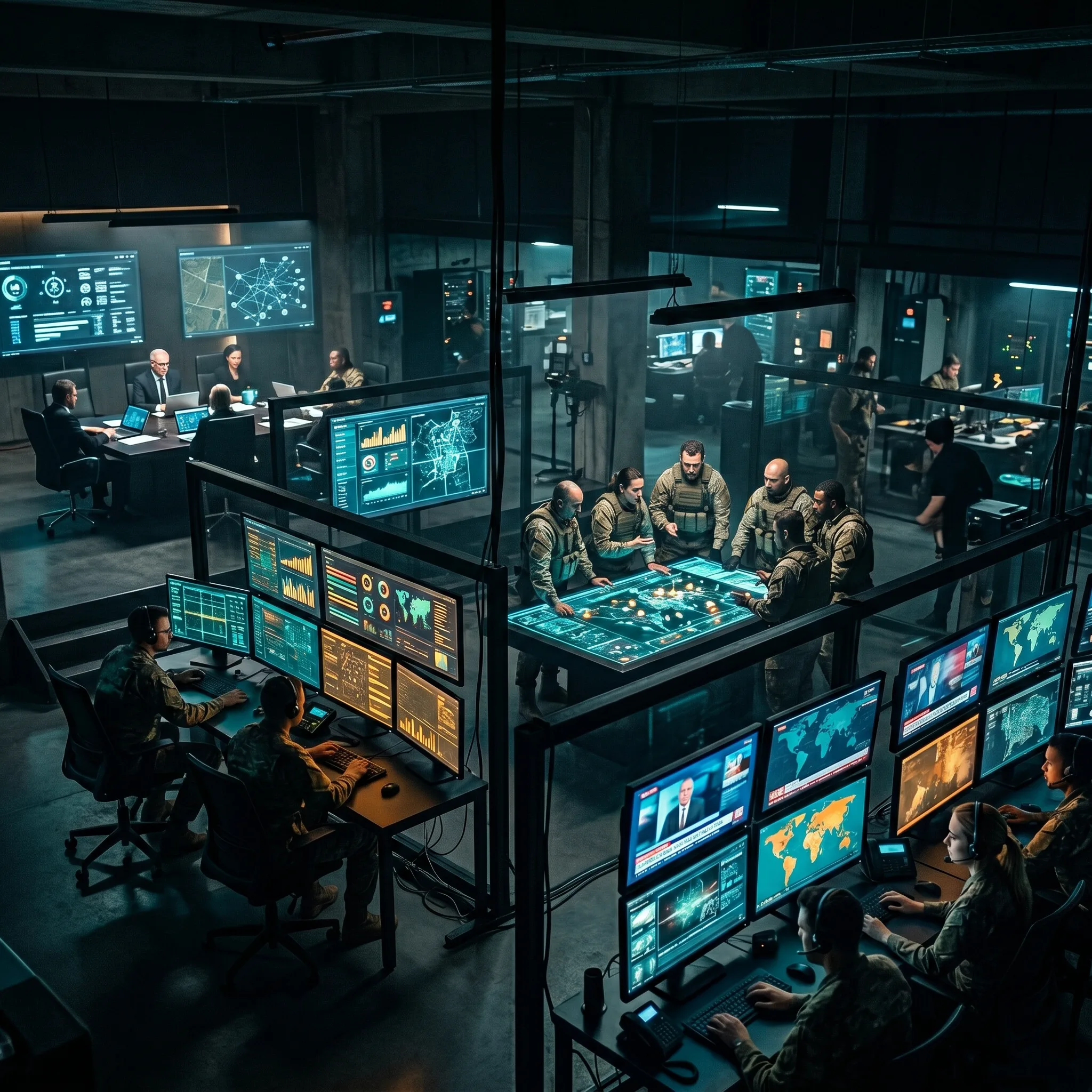
Quick Answers: MAC Groups Under NIMS
What Is a MAC Group?
A Multiagency Coordination (MAC) Group is a policy-level body of agency administrators and senior executives — not operations staff — that coordinates strategic decisions across multiple agencies during a major incident or competing incidents. MAC Groups do not run the incident. They prioritize resources across jurisdictions, resolve policy conflicts, and authorize strategic direction. Under NIMS, MAC Groups are one of four structures inside the Command and Coordination component, alongside ICS, Emergency Operations Centers, and the Joint Information System.
MAC Group vs. EOC vs. Incident Command
| Structure | Level | Composition | Authority | Operates |
|---|---|---|---|---|
| Incident Command (ICS) | Tactical | Incident Commander, Command & General Staff | On-scene tactical command of the response | At or near the incident |
| Emergency Operations Center | Operational coordination | EM director, agency liaisons, support staff | Resource and information coordination across the jurisdiction — not in command of the incident | Off-scene, jurisdiction-wide |
| MAC Group | Strategic / policy | Agency administrators, senior executives, elected officials | Strategic prioritization across multiple incidents or jurisdictions; policy decisions | Off-scene, often state-level |
| Joint Information System (JIS) | Public messaging | PIOs from each participating agency | Coordinated public information across all responding agencies | Wherever JIC personnel sit |
Unified Command is not a separate structure — it is a mode of ICS used when multiple agencies share jurisdictional authority over the same incident. The MAC Group sits above Unified Command, not alongside it.
Why the Term Confuses Everyone
Ask five seasoned emergency managers what a "multi-agency coordination system" is and you will get five different answers. Some will describe their EOC. Some will describe a mutual aid agreement. Some will reference an old IS-701 course they took a decade ago. One will probably tell you nobody uses that term anymore.
They are all partly right, and all partly wrong. Multiagency Coordination under NIMS is one of the most misunderstood terms in emergency management — not because the doctrine is unclear, but because it was quietly redefined, and most practitioners never got the memo.
The Term That Changed Meaning
Here is a fact that surprises even veteran emergency managers: FEMA retired the standalone IS-701.A "NIMS Multiagency Coordination System (MACS)" course in September 2016 without a direct replacement. The concept was not eliminated. It was absorbed.
When FEMA released the refreshed NIMS Third Edition in October 2017, it did something important. It repurposed "Multiagency Coordination" as the umbrella term for the entire NIMS Command and Coordination component. MACS is no longer a separate system sitting alongside ICS. It is the framework that contains ICS — and three other structures alongside it.
This matters because when an agency searches for "multi-agency coordination system" or "multi-agency coordination software," what they actually need isn't a single tool. It is a clear-eyed understanding of the four NIMS Command and Coordination structures, and how the technology under each one has to work differently.
The Four Structures Under the Umbrella
Under current NIMS doctrine, Command and Coordination — the umbrella formerly labeled MACS in training — consists of four distinct structures:
Incident Command System (ICS). On-scene, tactical-level response — the operational core of NIMS ICS at the field level. This is where the Command Staff and General Staff actually run the incident using ICS 201 through ICS 221 — under a single Incident Commander or, when multiple agencies share jurisdiction over the same incident, a unified command. ICS has authority over the tactics of the response. Everything else supports it.
Emergency Operations Centers (EOCs). Off-scene support to ICS. The EOC is not in command of the incident. It coordinates resources, manages information across jurisdictions, and supports policy decisions. The most common doctrinal mistake in local government is treating the EOC as an alternate command post. It is not.
Multiagency Coordination (MAC) Groups. Policy-level bodies made up of agency administrators and senior executives — not operations staff. MAC Groups do not run the incident. They prioritize resources across competing incidents, resolve policy conflicts, and enable strategic decision-making across jurisdictions. When a state activates its MAC Group during a major disaster, elected officials and department heads are the ones sitting in it.
Joint Information System (JIS). The coordinated public information apparatus that ensures consistent messaging across agencies. Formalized as the fourth Command and Coordination structure in the 2017 refresh.
Three different authorities, one supporting discipline, one umbrella.
These four structures operate alongside NIMS principles that make coordination actually work — modular organization that lets the ICS org chart scale up or down with incident complexity, and the interoperability standards that let mutual aid resources plug into an incident without a week of onboarding. When a single incident outgrows a single IC, NIMS also provides Area Command as an adjacent structure for coordinating multiple concurrent incidents or large-scale incidents that share a resource pool. All of it sits inside the NIMS Command and Coordination component — one of three major NIMS components, alongside Resource Management and Communications and Information Management.
Why the Confusion Costs You
The operational cost of blurring these distinctions is real, and it shows up in two places.
The first is decision speed. When a resource request stalls because nobody knows whether the EOC can approve it, the ICS Logistics Section Chief has authority over it, or the MAC Group has to prioritize it against a competing incident — that is not a process problem. It is a doctrine problem masquerading as a software problem. Most multi-agency coordination software on the market makes it worse, because it presents every user with the same interface, the same workflows, and the same authorities. If the tool does not know the difference between a MAC Group member and a Division Supervisor, neither will the people using it.
The second cost is reimbursement. FEMA Public Assistance documentation requires clear accountability: who authorized this expense, when, under what authority, and why was it reasonable. When a jurisdiction cannot cleanly distinguish policy decisions (MAC Group), coordination decisions (EOC), and operational decisions (ICS) in its post-incident record, the paper trail gets murky. Murky paper trails lose audits. With federal cost-share proposals pushing more of the burden to state and local agencies, murky is no longer affordable.
What Multi-Agency Coordination Software Should Actually Do
Software that claims to enable multi-agency coordination has to respect the structure NIMS lays out. Not in a marketing brochure — in the data model itself.
That means the platform needs to know who is a MAC Group member versus an EOC coordinator versus a Division Supervisor, and surface different information, different approval authorities, and different decision rights to each. The organizational hierarchy should reflect unity of command the way ICS 203 defines it — preserving the Command Staff and General Staff structure, not collapsing everyone into a flat user list. Resource requests should route through the right authority path by default, with policy decisions captured as policy decisions and operational decisions captured as operational decisions.
It also means operational period architecture has to be real. MAC Groups and EOCs operate on different cycles than ICS. Planning Section briefings drive the ICS tempo. EOC shift changes drive the coordination tempo. MAC Group convenings drive the policy tempo. Software that flattens all activity into one timeline loses the distinctions that make after-action reviews meaningful and FEMA documentation defensible.
This is the approach platforms like NIMS Logic take — modeling the NIMS Command and Coordination structure into the data itself, so the documentation produced during an activation reflects the actual organizational reality of the response rather than a simplified dashboard view of it.
The Bottom Line
"Multi-agency coordination system" is not a product category. It is the NIMS doctrinal frame that organizes everything else. Agencies that treat it as a shopping term will end up with dashboards. Agencies that treat it as a doctrine problem — and demand software that respects the four distinct structures beneath the umbrella — will end up with systems that actually survive an activation, an audit, and an after-action review.
Coordinating across agencies?
Operational period architecture — different cycles for ICS, EOC, and MAC Group activity, all in one platform — is what NIMS Command and Coordination looks like in software.
See operational-period architecture →Ready to modernize your incident management?
See how NIMS Logic transforms emergency management from an administrative burden into operational advantage with real-time visibility and automated workflows.
Schedule a DemoPresident & Co-Founder
Martin brings over 40 years of emergency management experience to NIMS Logic, including service as a Type 1 Incident Commander. His field expertise in ICS operations, multi-agency coordination, and FEMA cost recovery drives the platform's operational design.
Continue Reading
MAC Group vs. EOC vs. Unified Command: Who Actually Has Authority When Incidents Escalate
May 26, 2026
Three different authorities, three different jobs. Here is the doctrine, the decision rights, and the escalation scenarios that decide which structure activates when.

The ICS Org Chart and the EOC Org Chart Are Not the Same Chart
August 16, 2026
Both are NIMS. But NIMS names three EOC structures, and the same section titles do different work on either side. Here is what actually differs.
NIMS Components Explained: Resource Management, Command & Coordination, and Communications
June 6, 2026
NIMS has three components — Resource Management, Command and Coordination, and Communications and Information Management. Here is what each one does.