
What EOC Directors Get Wrong About Real-Time Visibility
The Dashboard Fallacy
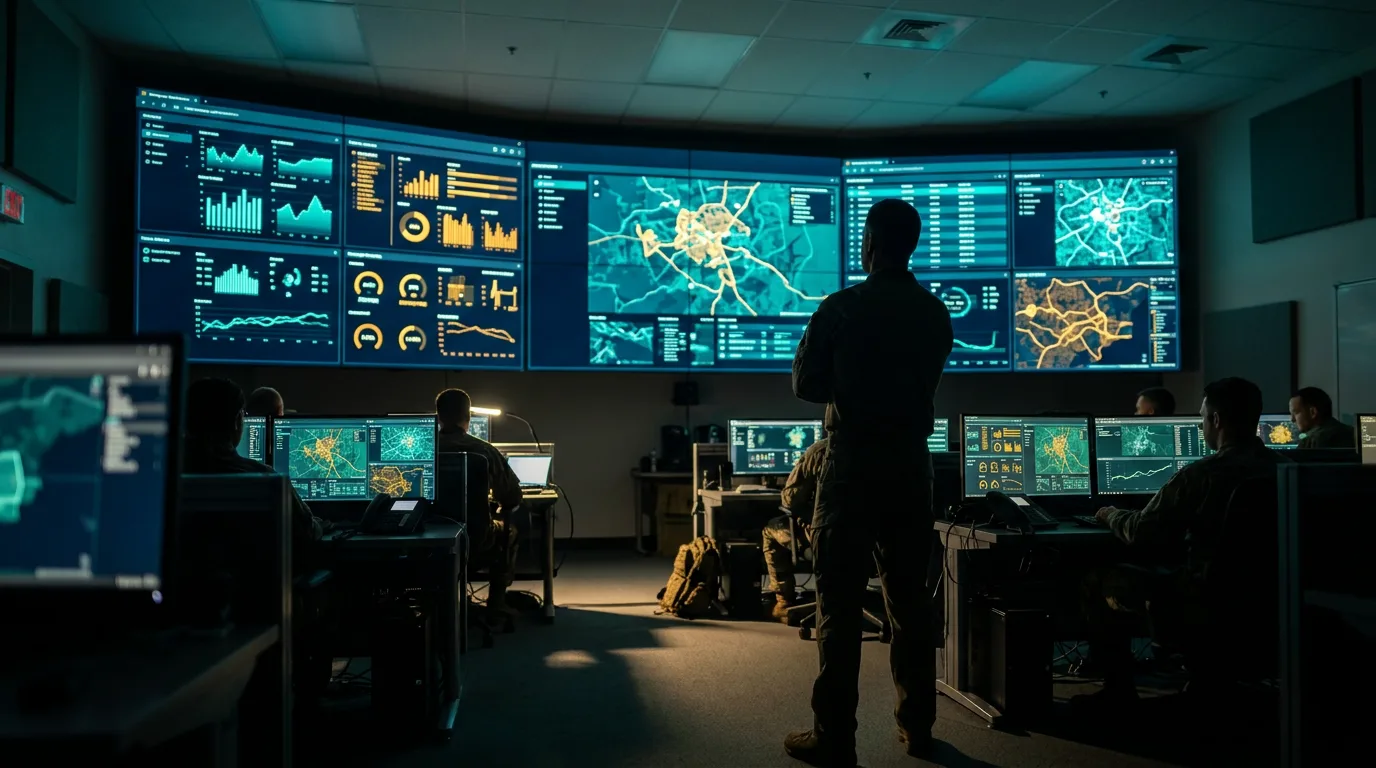
Walk into any modern Emergency Operations Center during an activation and you will see screens. Lots of screens. Weather radar on one wall, GIS layers on another, a WebEOC status board, maybe a scrolling news feed, and a handful of agency-specific dashboards refreshing at varying intervals. It looks like situational awareness. It feels like command and control.
But here is the uncomfortable question most EOC directors never ask: when the last major decision was made in this room, did anyone actually use those screens to make it — or did someone walk over to the liaison officer and ask what was really happening?
The distinction between having dashboards and having actionable situational awareness is the gap where multi-agency response coordination breaks down. And most emergency operations center software on the market today does nothing to close it.
Data Display Is Not Decision Support
The root of the problem is a misunderstanding about what real-time visibility actually means in an EOC context. Most EOC management software is built around data display — pulling information from various sources and rendering it on a screen. Map layers show resource positions. Status boards track which shelters are open. Feeds aggregate weather and media data. All of this is useful as background context.
But situational awareness, as any incident commander will tell you, is not the accumulation of data. It is the ability to understand what is happening, why it matters, and what is about to change. The National Incident Management System defines it clearly: situational awareness is the ability to identify, process, and comprehend the critical elements of an incident. The operative word is comprehend — not display.
When an EOC director looks at a dashboard showing 47 resources deployed across six divisions and three branches, the dashboard answers the question "what do we have out there?" It does not answer the questions that actually drive decisions: Which of those resources are approaching shift limits? Which divisions are burning through their assignments faster than planned? Where is the gap between what Operations requested in the ICS 215 and what the Logistics Section was able to fill? What changed in the last thirty minutes that the next briefing needs to address?
Those are the questions that define actionable situational awareness. And they require more than data on a screen — they require incident tracking software that understands the operational context behind the data.
The Multi-Agency Coordination Problem
The gap between dashboards and situational awareness widens dramatically during multi-agency response. When a single agency activates its EOC for a localized event, the information flow is manageable. The EOC director knows the players, the resources, and the operating procedures. The dashboards, limited as they are, at least reflect a single common operating picture.
Multi-agency response destroys that simplicity. Mutual aid resources arrive with their own tracking systems — or no tracking system at all. State and federal assets operate on different reporting timelines. NGOs and volunteer organizations are working adjacent to the incident but outside the formal ICS structure. Each agency has its own definition of what "real-time" means: one updates hourly, another pushes data every fifteen minutes, and the fire district running the field operation is updating status as fast as their division supervisors can radio it in.
The EOC dashboard faithfully displays all of this data, and the result is a mosaic of information captured at different times, from different sources, with different levels of reliability. The director looking at that screen has no way to distinguish between a resource status that was confirmed ninety seconds ago and one that has not been updated since the previous operational period.
This is where most emergency management software fails the people who depend on it most. The technology treats all data as equivalent. A resource position plotted on the map from a GPS ping has the same visual weight as a position entered manually by a harried logistics coordinator three hours ago. The dashboard does not know the difference. The EOC director should not have to guess.
What Actionable Situational Awareness Actually Requires
Closing the gap between data display and decision support requires emergency operations center software that is built around the operational rhythm of ICS, not bolted on top of generic dashboarding frameworks.
Temporal context on every data point. Every piece of information displayed in an EOC should carry its age. Not buried in a tooltip or available on hover — visible, immediate, and color-coded by staleness. When a resource status has not been updated in over an hour during an active operational period, that should be visually obvious to anyone glancing at the board. Stale data presented as current data is worse than no data at all, because it creates false confidence.
Operational period awareness. The operational period is the fundamental unit of time in ICS. EOC management software should organize information around it. What happened last period? What is the plan for the current period? What decisions need to be made before the next planning meeting? Dashboards that display data as a continuous stream, without reference to the operational period cycle, strip away the temporal framework that incident management teams use to make sense of complex situations.
Exception-based alerting, not status monitoring. An EOC director does not need to watch a screen showing that 93% of resources are operating as planned. The director needs to know about the 7% that are not — the crew that missed their check-in, the division that has been requesting additional resources for two periods without receiving them, the mutual aid engine company that was supposed to demobilize yesterday and is still showing as assigned. Incident tracking software that highlights deviations from the plan is fundamentally more useful than software that displays the plan.
Integrated resource lifecycle visibility. The most critical situational awareness gap in most EOCs is not weather data or map layers — it is resource status. Where is each resource? What is it assigned to? Who is supervising it? When does its assignment end? Has it been fed, rested, and properly supported? The answers to these questions live in the ICS 204 assignments, ICS 214 activity logs, and ICS 211 check-in records. When these data sources are disconnected — as they are in paper-based systems and most legacy software — the EOC director is assembling situational awareness manually from fragments.
The Briefing Test
Here is a practical test every EOC director should apply to their current technology: at the start of the next shift change briefing, could the incoming director look at the screens in the room and, within sixty seconds, answer these five questions?
- What is the current operational period and when does it end?
- How many resources are currently assigned, and how many of those have been updated in the last hour?
- What were the three most significant events since the last briefing?
- Which resource requests from Operations are unfilled?
- What is the current cost trajectory against the incident budget?
If the answer is no — if getting those answers requires opening multiple systems, calling down to the planning section, or digging through email — then the EOC has screens, not situational awareness. It has data, not intelligence. And in a multi-agency response where decisions must be made quickly, accurately, and with accountability, that gap is not a technology inconvenience. It is an operational liability.
Moving Beyond the Dashboard Mentality
The next generation of emergency management software must be designed around the decision cycle, not the data feed. EOC directors do not need more pixels. They need platforms that surface what matters, flag what changed, age what is stale, and organize everything around the operational period structure that ICS demands.
This is not a call for more dashboards or prettier visualizations. It is a call for incident tracking software that is operationally aware — that understands the difference between a shelter status board and a resource tracking system, between displayed data and decision-ready intelligence.
The agencies that recognize this distinction and invest in tools built around it will run more effective activations, make better-informed decisions, and produce the kind of documented operational records that support after-action reviews and FEMA reimbursement alike. The ones that keep buying screens will keep wondering why their EOC looks like a command center but does not run like one.
Explore how NIMS Logic delivers operational awareness, not just dashboards.
Ready to modernize your incident management?
See how NIMS Logic transforms emergency management from an administrative burden into operational advantage with real-time visibility and automated workflows.
Schedule a DemoPresident & Co-Founder
Martin brings over 40 years of emergency management experience to NIMS Logic, including service as a Type 1 Incident Commander. His field expertise in ICS operations, multi-agency coordination, and FEMA cost recovery drives the platform's operational design.
Continue Reading
The Whiteboard, the Spreadsheet, and the Group Text: How Most EOCs Actually Run
July 3, 2026
The EOC tech stack in the plan is not the one in the room. A look at the tools coordination actually runs on — and the exact load at which each one fails.
The EOC Battle Rhythm: Your EOC Should Not Be Running the Incident’s Clock
September 1, 2026
FEMA doctrine lets the EOC run a different operational period than the incident. Here is how to set that clock, hold it, and keep the two synchronized.

EOC Activation Levels: What Actually Changes When You Go to Level 2
August 22, 2026
Three levels, one real decision. What triggers each activation level, who holds authority to call it, and the staffing promise most jurisdictions cannot keep.