
NIMS and ICS Explained: The Relationship That Most Practitioners Get Wrong
Quick Answers: NIMS vs. ICS
Are NIMS and ICS the Same?
No. NIMS is the national framework that standardizes how agencies prepare for and manage incidents. ICS is one of four command and coordination structures inside NIMS — the on-scene tactical system. Every ICS activation is NIMS-compliant by design, but NIMS covers a much wider scope than ICS alone.
What's the Difference Between NIMS and ICS?
NIMS is the doctrinal framework — common terminology, resource typing, and coordination standards across federal, state, tribal, and local agencies. ICS is the on-scene management structure that runs the incident itself, with defined positions, forms, and operational periods. NIMS sets the rules; ICS executes the response.
What's the Relationship Between NIMS and ICS?
ICS is a component of NIMS. Specifically, ICS is one of four structures inside the NIMS Command and Coordination component, alongside Emergency Operations Centers, Multiagency Coordination Groups, and the Joint Information System. NIMS adopted ICS wholesale because ICS already worked at the tactical level.
Are NIMS and ICS Interchangeable?
No. Treating NIMS and ICS as interchangeable is the most common terminology error in emergency management. It causes RFP scoping mistakes, thin FEMA Public Assistance documentation, and training gaps. ICS handles tactics on-scene; NIMS handles coordination, communications, and resource management across jurisdictions.
The Most Misread Terminology in Emergency Management
Ask five emergency managers what "NIMS ICS" means and you will get three answers. Some will use NIMS and ICS interchangeably. Some will describe NIMS as a federal requirement and ICS as the tactical framework you use when you actually respond to an incident. A handful will draw the distinction correctly — NIMS is the national framework, ICS is one component of it — and then immediately muddle the terms again the next time they talk about training or software procurement.
The confusion is understandable. NIMS and ICS are tightly bound in every activation, every after-action report, and every federal grant reporting form. But the distinction is real, and it matters — especially when an agency is buying software, training staff, or defending a FEMA Public Assistance documentation package under audit.
What NIMS Actually Is
NIMS — the National Incident Management System — is the federal framework that standardizes how the nation prepares for, responds to, recovers from, and mitigates incidents. Issued by FEMA and most recently refreshed in October 2017, NIMS is not a tool, not a software package, and not a response method. It is a doctrinal framework that establishes common standards, terminology, and processes so that federal, state, tribal, territorial, and local agencies can work together during any incident of any scale.
NIMS contains three major components: Resource Management, Command and Coordination, and Communications and Information Management. (For a full breakdown of all three, see NIMS Components Explained.) Inside the Command and Coordination component sit four structures: the Incident Command System (ICS), Emergency Operations Centers (EOCs), Multiagency Coordination (MAC) Groups, and the Joint Information System (JIS). ICS is one of the four.
That is the first clarification to hold onto: ICS is a component of NIMS, not the same thing as NIMS.
What ICS Actually Is
ICS — the Incident Command System — is the on-scene, tactical-level management structure that runs the incident itself. It predates NIMS by decades, originating in the 1970s out of Southern California wildfire response. NIMS adopted ICS wholesale as its on-scene command structure because ICS already worked.
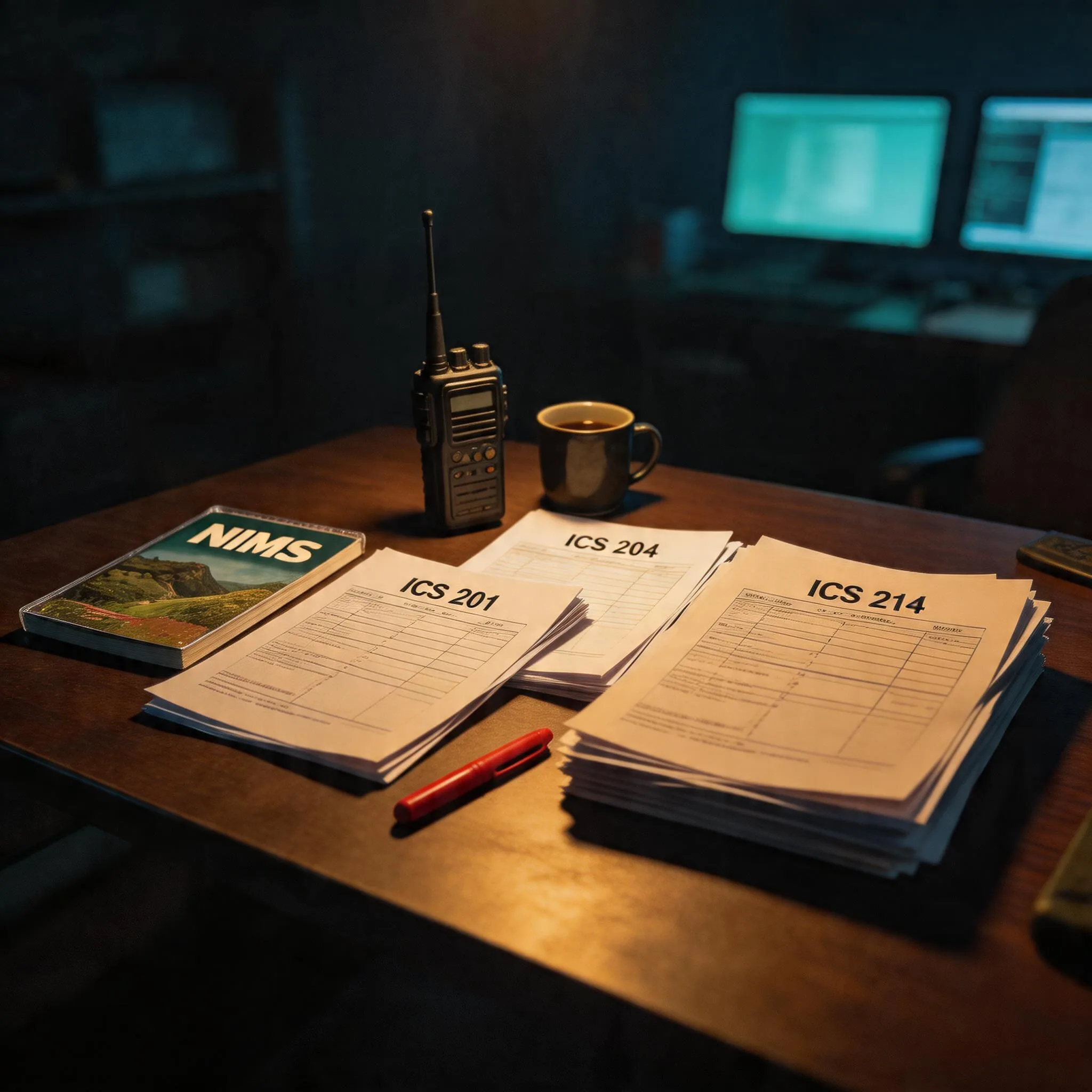
ICS is what responders use in the Incident Command Post. It defines the organizational hierarchy (ICS 203), assignment structure (ICS 204), activity logging (ICS 214), check-in (ICS 211), and demobilization (ICS 221). It enforces unity of command, modular organization, management by objectives, and span of control. It is the operational spine of any activation.
ICS runs the incident. NIMS provides the framework in which ICS operates.
Where They Overlap and Where They Don't
The overlap is real. Every ICS form is also a NIMS form. Every ICS principle is also a NIMS principle. Every activation that runs ICS correctly is also NIMS-compliant — by design.
The distinction is what most practitioners miss. NIMS covers the space off-scene and across jurisdictions that ICS does not touch. EOC coordination, MAC Group policy decisions, and joint public information are all NIMS — and all outside the ICS boundary. When an incident activates multiple agencies, runs for multiple operational periods, or requires policy-level resource prioritization across competing incidents, the coordination structures doing that work are NIMS structures. ICS handles the tactics; NIMS handles everything else.
This is why "NIMS training" and "ICS training" are not interchangeable terms. IS-100 and IS-200 are ICS courses. IS-700 and IS-800 are NIMS courses. An agency can be strong at ICS and weak at the broader NIMS coordination picture. Most agencies are.
Why the Distinction Matters in Practice
Three places where conflating NIMS and ICS quietly costs agencies money or credibility.
Procurement. An agency that issues an RFP for "NIMS software" and then accepts a tool that only digitizes ICS forms has bought the wrong product. Real NIMS ICS software has to respect the broader framework — organizational hierarchy across jurisdictions, resource typing, multi-agency coordination visibility, EOC information flow. Tools that only do ICS are tools that cover one-quarter of the Command and Coordination component, not the whole framework.
FEMA documentation. Public Assistance auditors ask for documentation aligned to the entire incident response — not just what happened on-scene. A PW package built entirely from ICS forms is missing the EOC coordination record, MAC Group decisions, and the resource management paper trail. Agencies that conflate NIMS with ICS tend to submit thin PW packages and take reimbursement reductions they did not need to.
Training gaps. Response agencies that train exclusively on ICS develop strong tactical execution and weak multi-agency coordination. In a real multi-jurisdictional incident, that gap shows up as delayed decisions, broken situational awareness, and the kind of coordination failures that make the local news.
What NIMS ICS Software Should Actually Do
If a platform is going to earn the label "NIMS ICS software," it has to respect both layers. ICS-native operational execution on the one hand — the forms, the operational period cycle, the resource lifecycle from check-in to demobilization. And NIMS-native coordination on the other — the EOC interface, MAC Group decision capture, multi-agency resource visibility, and the documentation that connects tactical ICS activity to broader NIMS coordination outputs.
Platforms that treat ICS as the product and NIMS as a marketing label produce tools that digitize a quarter of the picture and call it complete. Platforms built on the full NIMS framework — with ICS as the operational component inside it — produce the kind of documentation and visibility that survive an activation, an audit, and an after-action review.
That is the distinction practitioners need to hold onto. NIMS is the framework. ICS is the component that runs the incident. The best tools respect both.
Operationalizing NIMS in software?
A platform built on the ICS data model — the operational period, organizational hierarchy, and resource lifecycle — is what NIMS-compliant procurement actually looks like.
See the ICS data model →Ready to modernize your incident management?
See how NIMS Logic transforms emergency management from an administrative burden into operational advantage with real-time visibility and automated workflows.
Schedule a DemoPresident & Co-Founder
Martin brings over 40 years of emergency management experience to NIMS Logic, including service as a Type 1 Incident Commander. His field expertise in ICS operations, multi-agency coordination, and FEMA cost recovery drives the platform's operational design.
Continue Reading
NIMS Components Explained: Resource Management, Command & Coordination, and Communications
June 6, 2026
NIMS has three components — Resource Management, Command and Coordination, and Communications and Information Management. Here is what each one does.

The ICS Org Chart and the EOC Org Chart Are Not the Same Chart
August 16, 2026
Both are NIMS. But NIMS names three EOC structures, and the same section titles do different work on either side. Here is what actually differs.
Multi-Agency Coordination Systems, Explained: What MACS Actually Means Under NIMS Today
April 2, 2026
Multi-agency coordination is not one system — under NIMS, it is the umbrella for ICS, EOCs, MAC Groups, and JIS. Here is what the doctrine actually says.