
The Whiteboard, the Spreadsheet, and the Group Text: How Most EOCs Actually Run
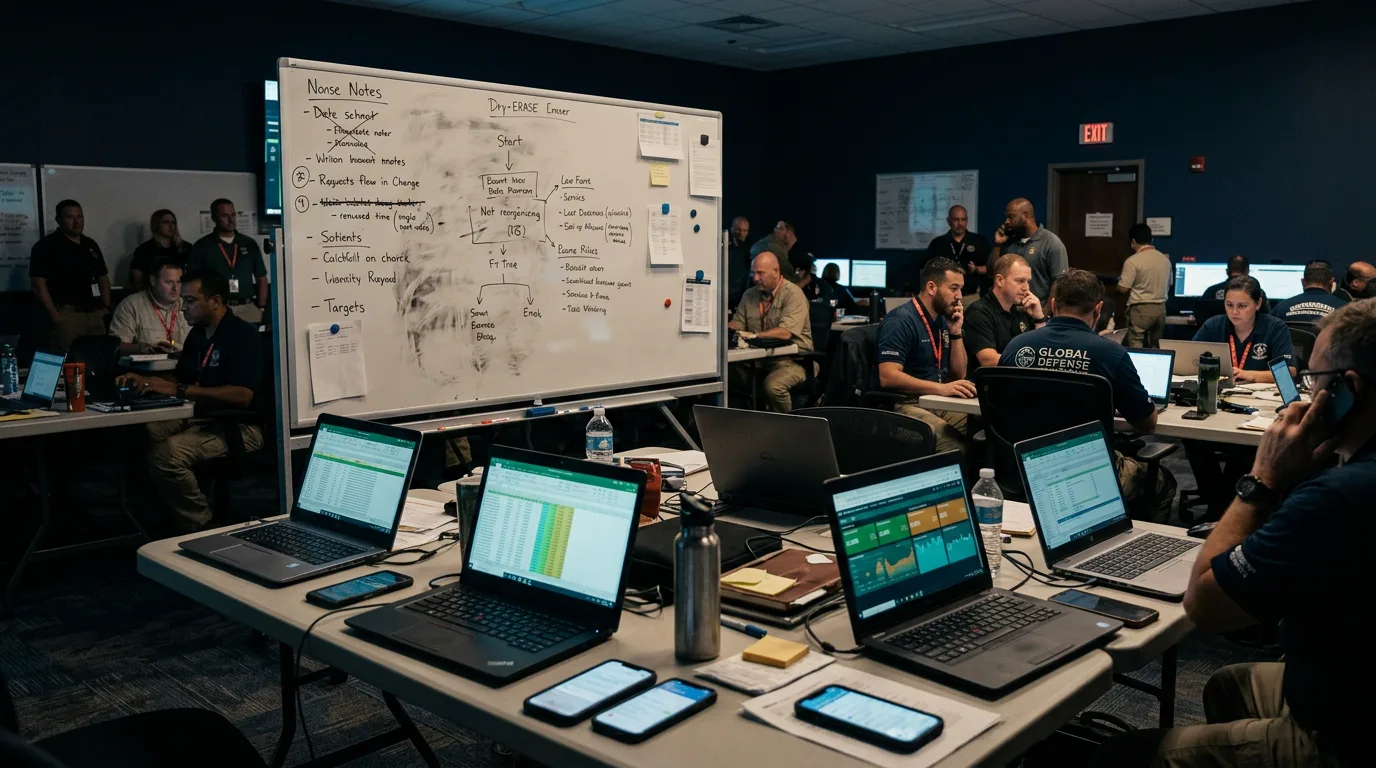
Walk into any EOC during a real activation and compare what you see to what the emergency operations plan says is in the room. The plan describes a coordination system. The room contains a whiteboard, a laptop with a spreadsheet on it, a radio log, and a group text that three people are watching and two people are not.
This is not a criticism. It is the actual operating substrate of American emergency management, and it persists because it works — right up until it doesn't. Understanding exactly where the failure point sits is more useful than pretending the stack is something else.
The Stack Nobody Documents
Four tools do most of the work in most EOCs:
- The status whiteboard — the live picture. Resources, assignments, open requests, road closures.
- The spreadsheet — resource requests, usually one row per request, usually owned by one person.
- The radio or phone log — the record of who called and what they wanted.
- The group text or chat channel — where the actual coordination happens, because it is faster than everything else.
None of these were selected. They accumulated. And each one earned its place by being the fastest available option at the moment somebody needed it.
The Whiteboard Wins for Good Reasons
It is worth being honest about why the whiteboard survives every attempt to replace it. It is instantly readable from across the room. It requires no login. It never goes down. A section chief can stand in front of it and brief six people without anyone looking at a screen.
Any system that replaces it has to be faster than a marker. Most aren't, which is why most don't.
Where Each One Breaks
The failure modes are specific and they are predictable.
Status decay. Updating the board is a separate action from doing the work. Every change has to be noticed, carried across the room, and written down by someone who has three other jobs. As tempo rises, board updates get less frequent — so the board is least accurate at exactly the moment decisions depend on it most.
Request black holes. A resource request enters the spreadsheet and the requester loses visibility. The EOC is supposed to be the single source for requesting resources across the jurisdiction and from surrounding ones, tracking each request from submission through fill, handoff to the incident, and eventual release. A spreadsheet row holds the request. It does not hold the status, the ETA, or the answer to the only question the requester has: is it coming?
Phone-tag resource hunting. Because the spreadsheet cannot answer that question, the requester calls. Someone in the EOC now stops coordinating in order to look something up and call back. Multiply by a busy operational period.
Channel fragmentation. The group text carries the real decisions. It is also invisible to anyone not on it, unsearchable after the fact, and gone entirely when the phone that held it goes home at shift change.
The Shift Change Test
Here is the cleanest diagnostic for any EOC's tooling, and it costs nothing to run.
At shift change, hand the room to the incoming team and leave. Do not brief them verbally. Can they reconstruct the current picture — every open request, every committed resource, every pending decision — from the artifacts in the room alone?
Almost nowhere passes. What actually transfers at shift change is the outgoing coordinator's memory, delivered verbally in fifteen minutes, and whatever survives that conversation is the operating picture for the next twelve hours. The whiteboard, spreadsheet, and group text are not the record. They are prompts for a person who is about to go home.
The Real Requirement
This is the layer beneath the dashboard argument. Dashboards are a display problem — and a dashboard showing stale data is worse than no dashboard. But display can only be as good as capture, and capture is where the whiteboard-and-spreadsheet stack actually fails.
The requirement is not a better display. It is that the status change and the record of the status change be the same action. When a resource is committed, assigned, or released, that is the update — not a thing somebody has to remember to go write down. When a request moves, the requester sees it move without calling anyone.
Get that right and the board stops decaying, because nobody is maintaining a board. The picture is a view of work that already happened, and it survives shift change because it was never in anyone's head to begin with.
See how NIMS Logic keeps the EOC's resource picture current without anyone maintaining it. Explore the platform.
Ready to modernize your incident management?
See how NIMS Logic transforms emergency management from an administrative burden into operational advantage with real-time visibility and automated workflows.
Schedule a DemoPresident & Co-Founder
Martin brings over 40 years of emergency management experience to NIMS Logic, including service as a Type 1 Incident Commander. His field expertise in ICS operations, multi-agency coordination, and FEMA cost recovery drives the platform's operational design.
Continue Reading
The EOC Battle Rhythm: Your EOC Should Not Be Running the Incident’s Clock
September 1, 2026
FEMA doctrine lets the EOC run a different operational period than the incident. Here is how to set that clock, hold it, and keep the two synchronized.
EOC Activation Levels: What Actually Changes When You Go to Level 2
August 22, 2026
Three levels, one real decision. What triggers each activation level, who holds authority to call it, and the staffing promise most jurisdictions cannot keep.
What EOC Directors Get Wrong About Real-Time Visibility
March 13, 2026
Dashboards are not situational awareness. Learn why most EOCs mistake data display for actionable intelligence during multi-agency incident response.