
Deactivating the EOC: The Transition Nobody Plans
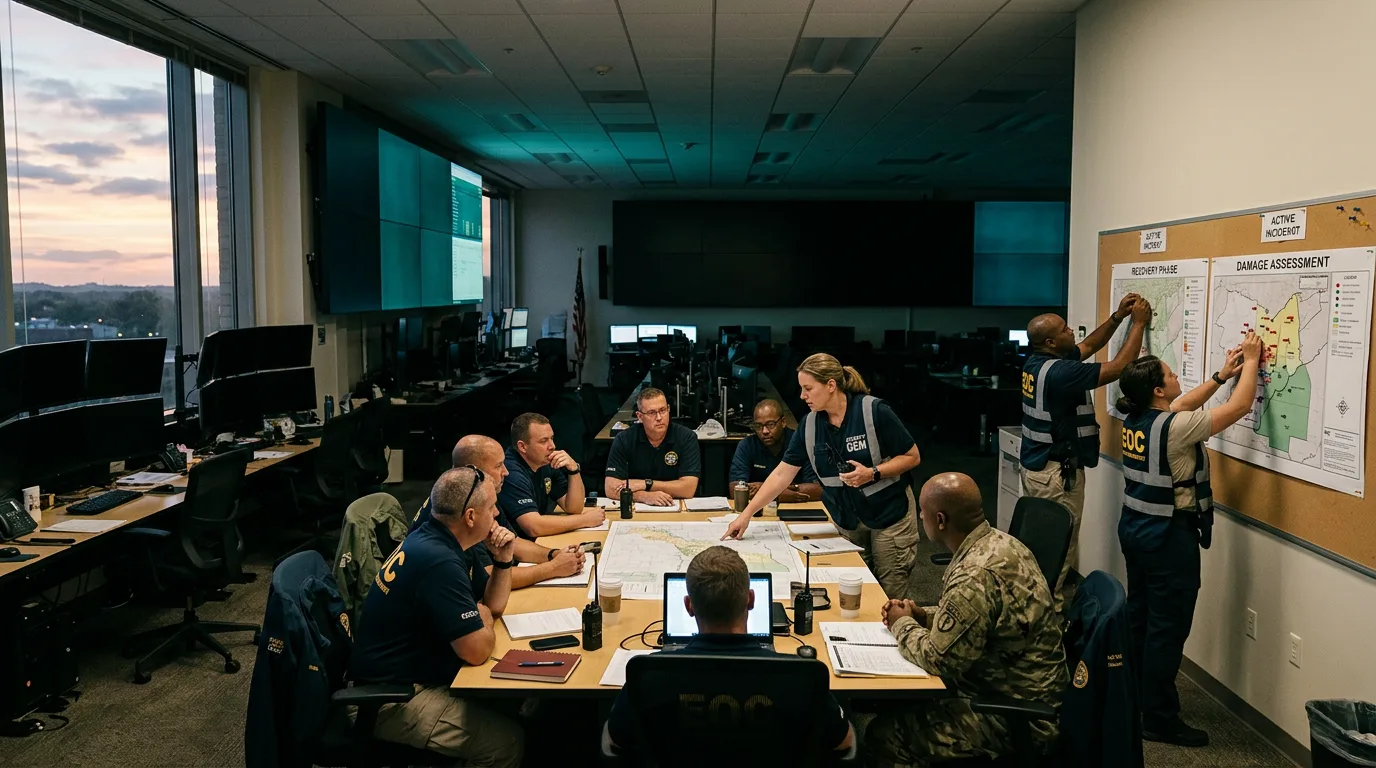
EOCs activate on written triggers. Most of them deactivate on a feeling.
The SitRep has less to say each cycle. Partner agency seats empty out one at a time. Someone eventually says "I think we can stand down," and the EOC goes from Level 1 to closed in an afternoon. What happens to the open action items, the recovery coordination that just started, and the half-finished activity logs is left to whoever is still in the building.
The Same Argument, One Echelon Up
We argued in demobilization planning starts at check-in that releasing incident resources is a planning function, not a closeout chore. The incident has to plan its drawdown while it still has the capacity to plan, because that capacity is exactly what leaves during demobilization.
EOC deactivation is the same problem at the coordination level. The work of stepping down, deciding what transfers, to whom, and when, needs the EOC's full situational picture and its decision-makers in the room. Those are the first things to go when the tempo drops. An EOC that plans deactivation only once it feels quiet is planning with half its staff.
Step Down Through the Levels You Stepped Up Through
Activation levels work in both directions. The written triggers that moved you from Level 3 to Level 2 to Level 1 should have mirror-image triggers for coming back down. Each step down is a deliberate decision, not a drift.
Common deactivation triggers are well established in local plans: the incident has de-escalated to the point of local agency control, response operations have ended, and recovery operations are underway. Make them specific enough that two people would agree whether they have been met.
At each step down, the same four things that changed on the way up should change in reverse:
- Who reports in. Which positions stand down, and on what date.
- What products are due. The SitRep cadence relaxes, and the EOC action plan narrows to what remains.
- What decisions move. Approvals that moved to the EOC go back to normal channels, and everyone should know that they have.
- Who gets told. Partner agencies, the state, elected officials, and the public information function, with a date, not just "soon."
Going too early has a cost. Problems come back and recovery is left without support. Going too late has a cost too: staff and resources sit idle that their home agencies need back. Written triggers keep the decision from turning on who is most tired.
Hand Off Recovery, Don't Abandon It
The hardest part of deactivation is not shutting down response functions. It is handing recovery to something that will still exist next month.
Recovery work starts inside the EOC: tracking community impacts, early damage assessment, coordination with state partners on assistance. FEMA's EOC Skillsets include a Recovery Coordination skillset for exactly this, covering understanding community impacts and preparing for long-term recovery. When the EOC closes, that work has to move into the long-term recovery structure, with named owners.
Colorado's recovery planning guidance makes the timing point directly: transition planning should happen before the EOC demobilizes, ideally during pre-disaster recovery planning, and the transition happens in steps over time, not all at once. If the handoff is not designed before the incident, it gets improvised in the last week by the people who are still there.
A practical test: list every open action item on the EOC's tracker. For each one, name who owns it after deactivation. Any item without an owner outside the EOC will be dropped once the room is empty.
Close the Record While the Authors Are Still Here
The documentation side of deactivation is the most predictable failure and the cheapest to prevent.
School district and municipal EOC deactivation checklists say the same thing in plain language: finalize and save the SitRep, complete activity logs, finalize and file all incident documents, return equipment. None of it is complicated. The difficulty is timing. Once staff go back to their home agencies, an incomplete activity log stays incomplete.
That record has at least two more audiences. The after-action report is only as good as the record it is built from. And the EOC's own operating costs, such as staff time, facility, and supplies, have to be documented if they are going to be claimed. A deactivation checklist that ends with "turn off the lights" and not "confirm every log is closed" leaves both at risk.
When the EOC's records are produced as part of running it, with logs, actions, and decisions captured as they happen in each operational period, closing the record means confirming it is complete, not writing it. That is the difference between a deactivation that takes an afternoon and one that is still turning up missing logs three months later.
Plan the Exit When You Plan the Entry
This series started with how most EOCs actually run and ends here, at the transition almost nobody writes down. The thread through all of it is the same: the EOC performs well when the decisions that matter are made in advance, by people with time to think.
Deactivation fits that pattern exactly. Write the step-down triggers next to the step-up triggers. Make the recovery handoff part of the recovery plan. Put "close the record" on the checklist above "release staff." And staff the step-down with the bench you built for activation, so the people closing the EOC are qualified to do it.
See how NIMS Logic keeps EOC records current through every operational period, so deactivation is a review, not a reconstruction. Explore the EOC solution.
Ready to modernize your incident management?
See how NIMS Logic transforms emergency management from an administrative burden into operational advantage with real-time visibility and automated workflows.
Schedule a DemoPresident & Co-Founder
Martin brings over 40 years of emergency management experience to NIMS Logic, including service as a Type 1 Incident Commander. His field expertise in ICS operations, multi-agency coordination, and FEMA cost recovery drives the platform's operational design.
Continue Reading

Staffing the EOC You Actually Have: NQS Skillsets and Position Task Books
September 10, 2026
Your EOC structure should follow from who you can staff at 0200. How FEMA NQS EOC Skillsets and Position Task Books build qualified depth for any EOC.
The EOC Battle Rhythm: Your EOC Should Not Be Running the Incident’s Clock
September 1, 2026
FEMA doctrine lets the EOC run a different operational period than the incident. Here is how to set that clock, hold it, and keep the two synchronized.

EOC Activation Levels: What Actually Changes When You Go to Level 2
August 22, 2026
Three levels, one real decision. What triggers each activation level, who holds authority to call it, and the staffing promise most jurisdictions cannot keep.