
Staffing the EOC You Actually Have: NQS Skillsets and Position Task Books
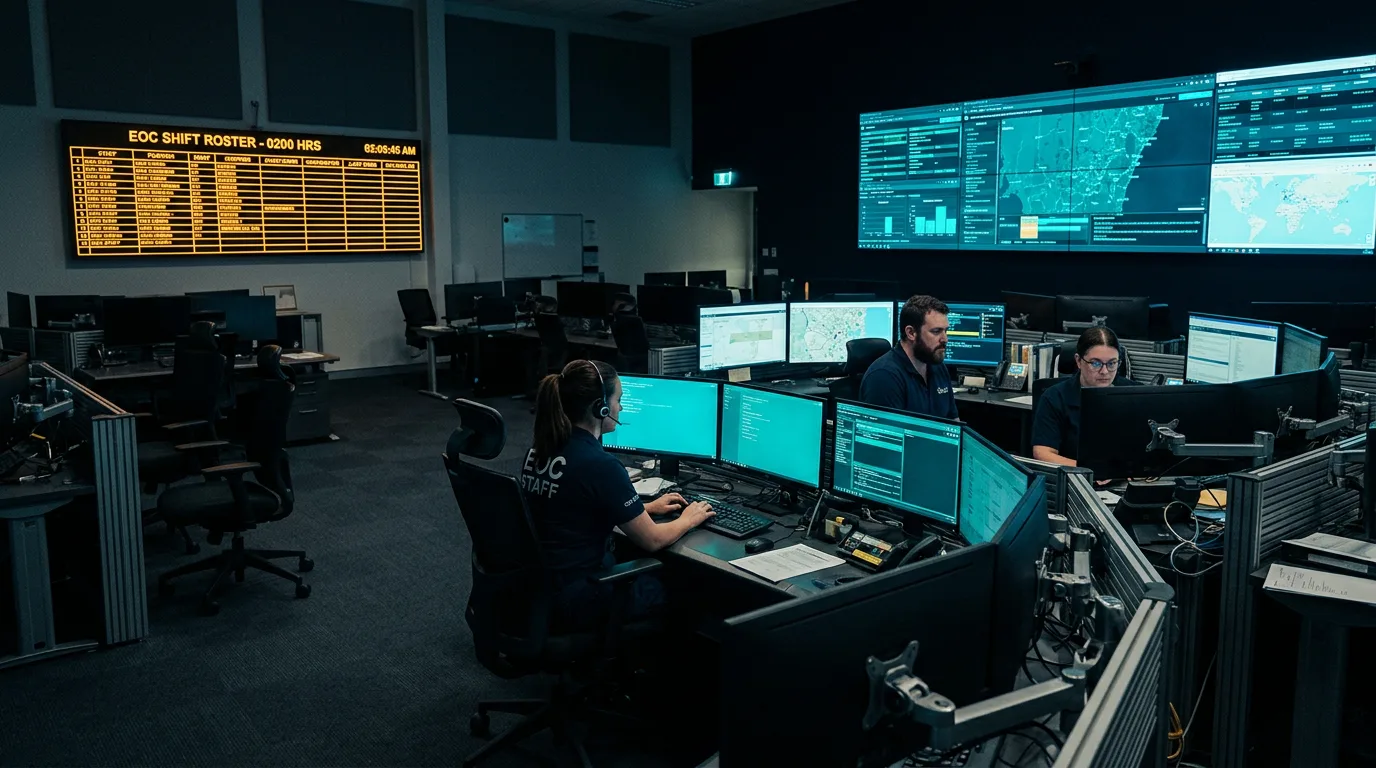
Every EOC has two org charts. One is on the wall. The other is whoever answered the callout at 0200 on the second night.
We made the case in the activation levels post that a Level 1 you cannot staff for 72 hours is really a Level 2 with an aspirational chart. This post is about closing that gap: building EOC staffing depth on purpose, with the qualification tools FEMA already publishes.
Structure Is Downstream of Staffing
Most EOCs choose a structure first and staff it second. ICS-like, Incident Support Model, Departmental. We covered what each of those looks like; the point here is the order of operations.
FEMA's own EOC Skillsets User Guide puts it plainly: EOC directors expand or contract their structures based on available personnel, and leaders should consider both minimum and maximum staffing levels when defining position responsibilities. Some incidents need several people on one function. Others need one person covering several.
That is the honest planning question. Not "what does our chart look like at full strength?" but "what does it look like with the eleven people we can actually put in the room for three operational periods?"
Skillsets Are the Building Blocks
The National Qualification System gives on-scene personnel ICS position task books. EOCs never had an equivalent, because there is no national standard EOC structure. Every jurisdiction titles and scopes its positions differently.
EOC Skillsets solve that without forcing a structure on anyone. There are 17 functional skillsets that define what a position does, including Situational Awareness, Resource Tracking, Resource Sourcing, Planning, Finance, Action Tracking, and Document and Records Management. There are three level-of-responsibility skillsets that define where the position sits: Coordination and Individual Contribution for everyone, Leadership for supervisors, and Policy and Direction for MAC Group or Policy Group members.
Three rules from the guide do most of the work:
- You can assign the same skillset to multiple positions.
- You can assign multiple skillsets to a single position.
- Every position gets a level-of-responsibility skillset.
Those first two rules are what make skillsets a staffing tool, not just a qualification tool. They let you design positions around the people you have.
Build the Task Books Around Your Thin Spots
The guide walks through three steps: settle your structure, build Position Task Books from the skillsets, then use the task books to qualify people. Done well, step two is where staffing depth gets built.
Start with the functions that collapse first on a long activation. In most EOCs that is Situational Awareness and Resource Tracking. Both run around the clock, both feed the SitRep and EOC action plan, and both tend to sit with one or two people who carry the whole picture in their heads.
Then build overlap deliberately. A Resource Tracking specialist whose task book also carries Document and Records Management can cover records when the shift is thin. A Planning lead who also holds Situational Awareness can run the planning meeting and update the picture in the same cycle. Each combined task book is a position you can still fill when the roster is short.
The guide also notes that skillsets set minimum baselines. You can add tasks specific to your hazards or your systems. If your EOC tracks resources in a particular platform, put the tasks for operating it in the book. A person who knows doctrine but cannot work your tools is not qualified for your seat.
Qualify Where the Work Happens
Each task carries codes for where it can be evaluated: classroom, tabletop, functional exercise, full-scale exercise, real-world incident, or day-to-day job duties. That last code matters more than most EOCs realize.
A large share of EOC work, such as tracking resources, managing records, and processing purchases, looks a lot like the steady-state work your staff already does. Task books that let evaluators sign off on job duties qualify people in months instead of waiting years for the right incident.
Exercises then become the place to test combinations. Run a functional exercise with the roster you would actually have on night two, with people working their secondary skillsets. You will find the gaps on a Tuesday afternoon instead of during the incident.
Name the Bench
Skillsets also give you a common vocabulary when you need outside help. The guide was written partly so EOCs could request personnel through mutual aid by capability, not by title, because your "Planning Chief" and a neighboring county's may do very different jobs.
That only works if you know which capabilities you are short. A simple bench list does it: each function, the people qualified to fill it, and how many operational periods that depth can sustain. Where the list runs to one name, you know what to train next and what to request first.
The activation levels you wrote down tell partners what you have promised. The bench list tells you whether you can keep the promise. Once it is honest, your battle rhythm is built on people who will actually be in the room.
See how NIMS Logic supports EOC teams with role-based coordination that works at whatever staffing level you can field. Explore the EOC solution.
Ready to modernize your incident management?
See how NIMS Logic transforms emergency management from an administrative burden into operational advantage with real-time visibility and automated workflows.
Schedule a DemoPresident & Co-Founder
Martin brings over 40 years of emergency management experience to NIMS Logic, including service as a Type 1 Incident Commander. His field expertise in ICS operations, multi-agency coordination, and FEMA cost recovery drives the platform's operational design.
Continue Reading

The ICS Org Chart and the EOC Org Chart Are Not the Same Chart
August 16, 2026
Both are NIMS. But NIMS names three EOC structures, and the same section titles do different work on either side. Here is what actually differs.
Deactivating the EOC: The Transition Nobody Plans
September 22, 2026
EOC deactivation is a planned step-down, not the moment the room empties. How to define triggers, hand off to recovery, and close the record before staff leave.
The EOC Battle Rhythm: Your EOC Should Not Be Running the Incident’s Clock
September 1, 2026
FEMA doctrine lets the EOC run a different operational period than the incident. Here is how to set that clock, hold it, and keep the two synchronized.