
Task Books Get Signed on Real Incidents: Qualification Evidence as a Byproduct of Operations
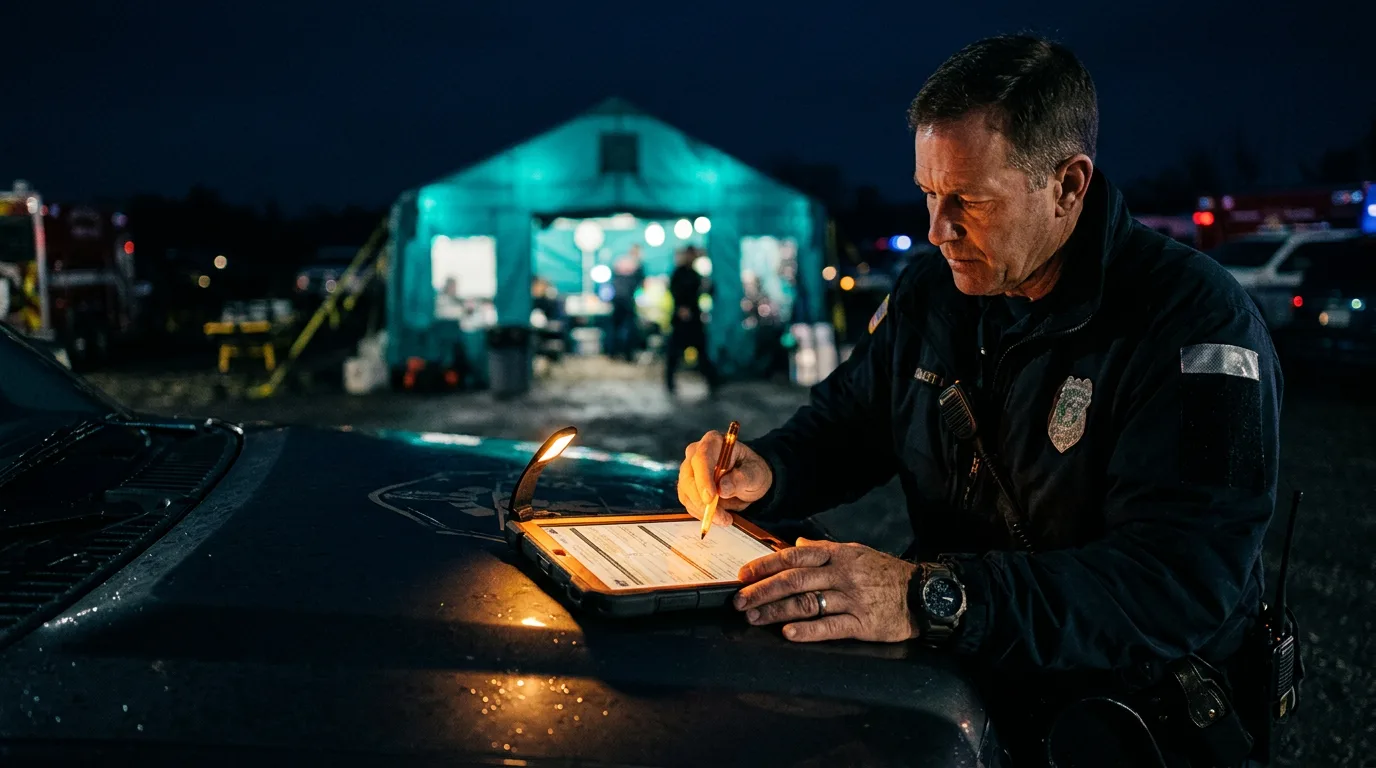
Last week we followed three field leaders through the jobs they actually do. Put a trainee in one of those seats, a Division Supervisor on night two, and someone will sign their position task book before the incident ends.
Months later a qualification review board opens that book and asks what backs the signatures. Most agencies find the answer is scattered across a box of incident paper, if it was kept at all.
Oregon Made the Deadline Real
On June 1, 2026, Oregon closed the Historical Recognition window for its State Qualification System. For two years Oregon OEM had accepted IAPs and ICS 225s from past incidents in place of a task book. Its December 2025 training update put the change plainly: "Starting June 1st 2026, Task books are required."
Oregon's 2026 guidance spells out what that means. A trainee "shall complete and be evaluated on at least two performance assignments before receiving certification." The supporting documentation it lists includes "IAPs, ICS-204s, AARs, products created." Most states haven't drawn the line that sharply yet, but the national system works the same way.
What Gets Signed, and Where
FEMA's NIMS Guideline for the National Qualification System makes the task book the record of performance. Evaluators use it to document the trainee's work during "qualifying incidents, events, job activities, exercises, or classroom activities." The guideline adds that trainees "generally demonstrate proficiency in actual incidents."
Three details trip people up:
- The evaluator doesn't have to hold the position. Under NQS, an evaluator can be the trainee's supervisor. The final evaluator is generally qualified in the position. NWCG is stricter: its final evaluator must be.
- The incident lives on the evaluation record. Each task line gets the evaluator's initials and date plus an evaluation record number. That record names the incident, its kind, the evaluation period, and the evaluator's own qualification.
- The clock is running. NQS says trainees are generally required to finish within five years. NWCG's PMS 310-1 gives a task book three years from initiation, reset at the first evaluation record.
What the Review Board Wants Next to It
The signatures aren't the whole packet. The QRB checklist in FEMA's NQS templates asks for the ICS 225 performance ratings and the ICS 214 activity log. It also asks that the incident action plans list the trainee's name, position, and incident. FEMA's guidance for evaluators asks for "records of expected actions and actual actions, and a detailed time record of observed events."
The ICS 225 is its own requirement. NQS says a task book "does not replace" it. The supervisor completes one after each assignment, and the form goes to the Planning Section Chief before the rater leaves the incident.
Every box above the review board is produced on the incident. That's the point. The evidence is a byproduct of running the operation correctly, or it doesn't exist.
Where the Packet Falls Apart
The incident records exist on paper and in theory. In practice, they break in the same few places:
- The IAP doesn't show the trainee. The 204 lists the qualified Supervisor and leaves the trainee off, so nothing ties the trainee to the position.
- The 214 is thin. A log that reads "worked Division A, no issues" can't show expected versus actual actions. We've covered why a 214 written after the fact doesn't hold up, and that applies here too.
- The 225 never happens. The rater demobilizes first and promises to send it later.
- The evaluation record gets written at home. Weeks later, from memory.
Build It Into the Incident
None of this needs a new program. It needs the trainee assignment handled as deliberately as any other assignment.
Put the trainee on the IAP. List them by name, position, and trainee status on the 203 and the 204 for every Operational Period they hold the seat.
Assign the evaluator in the same plan. Name who is evaluating, for which tasks, in the same period. It is a planned assignment, not a favor.
Have the trainee keep their own 214. It should be written so the evaluator can compare what was expected with what was done, with times. That's the documentation-as-accountability habit applied to qualification.
Collect the 225 before demobilization. Make it a checkout item, just like returning equipment. The demobilization plan is already the right place for it.
Close the evaluation record on scene. Incident name, kind, dates, and the evaluator's qualification, before anyone leaves.
The EOC staffing post made the same case for EOC skillsets. In the field the stakes are the same, but the window is shorter: once the incident demobilizes, the chance to collect this evidence is gone. Next in this series, the same ladder at the top: the Section Chief's path.
Ready to modernize your incident management?
See how NIMS Logic transforms emergency management from an administrative burden into operational advantage with real-time visibility and automated workflows.
Schedule a DemoPresident & Co-Founder
Martin brings over 40 years of emergency management experience to NIMS Logic, including service as a Type 1 Incident Commander. His field expertise in ICS operations, multi-agency coordination, and FEMA cost recovery drives the platform's operational design.
Continue Reading
Training the Field Leader: What Bosses, Strike Team Leaders, and Division Supervisors Actually Need
November 18, 2026
ICS gives field leaders three titles for three jobs: Boss, Leader, Supervisor. What each one directs, the document each owns, and how to train the step up.
The First Ten Minutes After Check-In: Training the Responder Who Just Arrived
November 11, 2026
Every responder passes through ICS check-in. Six things an arriving responder must know before the first assignment, and how to brief them in ten minutes.
Two Incidents a Year: Why Responder Skills Fade Between Activations
November 4, 2026
The research on skill decay is blunt: unused skills fade within months, and the procedural work of ICS fades fastest. What that means for responder training.