
Single Resource, Strike Team, Task Force: The Anatomy of an ICS Resource
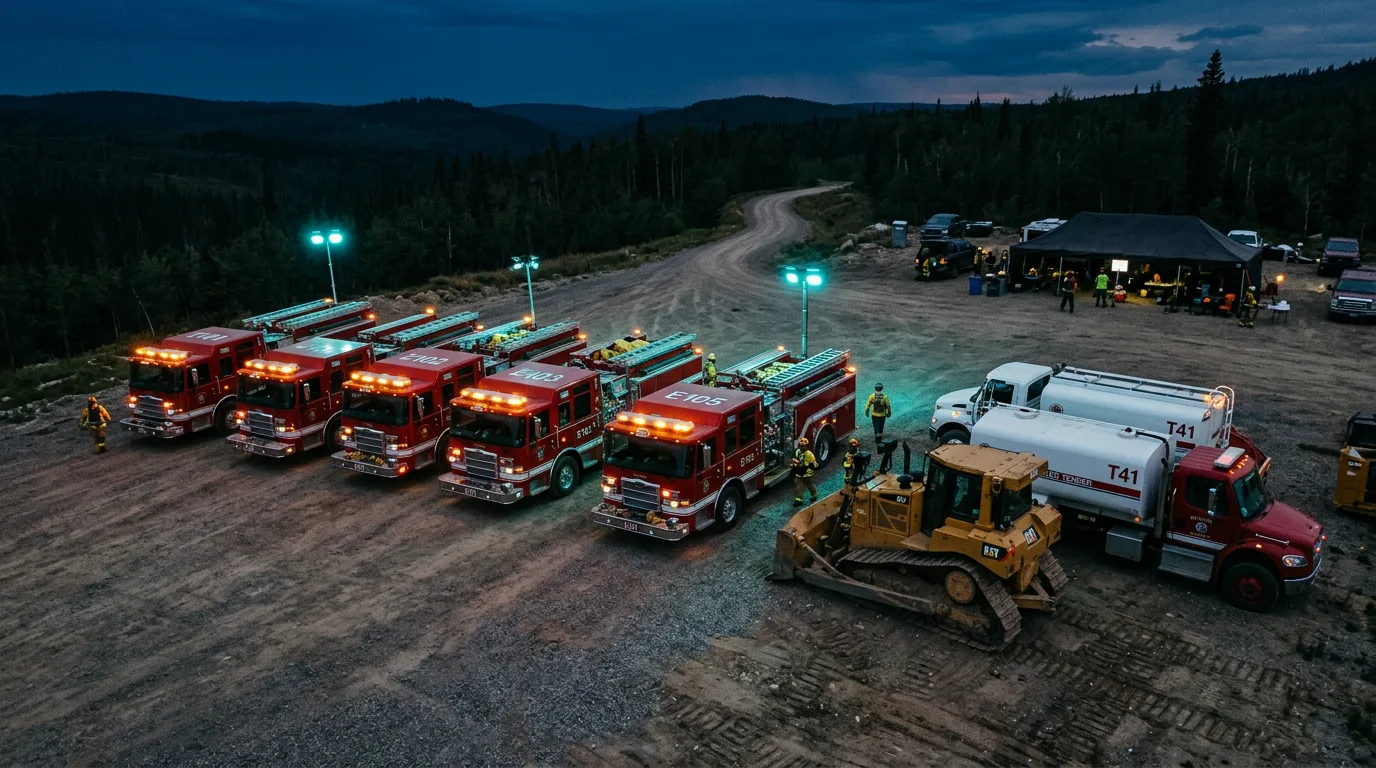
"Resource" is the most used word in incident management, and the one people get wrong most often. A resource isn't a person or a truck. A resource is what you assign. People and equipment are what it's made of.
ICS organizes them three ways: the single resource, the strike team, and the task force. Most of the confusion about resources comes down to a handful of rules about those three. This post lays them out, one section per rule, with a glossary at the end.
The Three Ways ICS Organizes Resources
The NIMS glossary defines a single resource as "an individual, a piece of equipment and its personnel complement, or a crew/team of individuals with an identified work supervisor that can be used on an incident." Strike teams and task forces are built from single resources. Each adds one leader who stands above the resources, not among them.
Rule 1: A Single Resource Takes One of Three Shapes
The glossary definition names three shapes, and every single resource fits one of them.
| Shape | What defines it | Examples |
|---|---|---|
| Equipment with personnel complement | A piece of equipment, plus whoever runs it | An engine and its crew; a dozer and its operator; an ambulance and its medics |
| Individual | One person, assigned alone | A Safety Officer; a paramedic sent alone; a deputy and their patrol car |
| Crew or team | Several people under a work supervisor | A hand crew, even with its buggies; a patrol team; a search team |
A quick field test: if the people walked away, would you still assign the equipment? If yes, it's equipment with its complement. If no, the resource is the person or the crew, and the equipment rides along.
Two things follow from the definition. First, a crew isn't a fourth container. NIMS has no separate entry for crews. A crew is a single resource that happens to be people. Second, an engine short a firefighter is still the same single resource. It's below its staffing, not a different kind of thing.
Rule 2: Alike Makes a Strike Team, Mixed Makes a Task Force
NIMS defines a strike team as a set number of resources "of the same kind and type" with an established minimum number of personnel, common communications, and a leader. Its example is five Type 3 dump trucks and a Strike Team Leader. A task force is any combination of resources of different kinds or types, assembled for a specific mission under a designated leader. The doctrine's flood example pairs a dump truck, a backhoe, and a five-person crew.
| Strike Team | Task Force | |
|---|---|---|
| Made of | Single resources of the same kind and type | Single resources of any mix of kinds and types |
| Example | Five Type 1 structural engines | Two engines, a dozer, and a water tender |
| Led by | Strike Team Leader | Task Force Leader |
| Communications | Common communications | Common communications |
| Counted as | Its single resources: "five engines" | Its single resources: "four resources" |
A few rules people get wrong:
- The team's kind follows from its makeup. Five ambulances under one leader are a strike team, not a task force, because they're alike.
- An engine and its operator isn't a task force. It's one single resource.
- The leader isn't one of the team's resources. Count five engines and a Strike Team Leader, not six.
- Below minimum is a warning, not a new type. A Type 1 engine strike team missing a firefighter is still that strike team, running below its minimum staffing.
- Law enforcement calls them resource teams. NIMS says so directly. A patrol resource team is a strike team by another name.
Rule 3: Bosses, Leaders, and Supervisors
ICS titles mark the level, and each level keeps its own. As we covered in training the field leader, the three field titles describe three different jobs.
| In charge of | ICS title | Examples |
|---|---|---|
| A single resource | Boss (its work supervisor) | Engine Boss, Crew Boss; a dozer's operator |
| A strike team | Leader | Strike Team Leader |
| A task force | Leader | Task Force Leader |
| A division or group | Supervisor | Division/Group Supervisor |
| A branch / a section | Director / Chief | Branch Director, Operations Section Chief |
Every single resource has someone in charge of it, even when that someone is the individual themselves. Titles don't migrate between levels. Staging is run by a Staging Area Manager, not a "Staging Supervisor." Supervisor is the division and group title.
Wildland agencies carry these as qualified positions in NWCG's Standards for Wildland Fire Position Qualifications (PMS 310-1), for example Engine Boss (ENGB) and Strike Team Leader Engine (STEN). Holding a seat on one incident isn't the same as holding the qualification. We made that case in training versus qualification.
Rule 4: NIMS Typing Is Capability, Category, Kind, Type
NIMS describes every resource with four labels:
- Capability: the core capability the resource serves.
- Category: the function it's most useful for, such as firefighting, law enforcement, or health and medical.
- Kind: a broad class: personnel, teams, facilities, equipment, or supplies.
- Type: its level of minimum capability to perform that function.
Single resource, strike team, and task force aren't kinds. They describe how resources are organized on the incident.
Type 1 is the most capable. NIMS says Type 1 is a higher capability than Type 2, which is higher than Type 3. Because type sets a minimum, a Type 1 resource can fill a Type 2 or Type 3 order of the same kind, and a Type 3 can't fill a Type 1 order. Kind matters as much as type: a Documentation Unit Leader isn't a Situation Unit Leader, whatever their type. (A resource's Type 1 has nothing to do with a Type 1 incident, which measures complexity.)
The national definitions and position titles live in FEMA's Resource Typing Library Tool (RTLT). Local names such as Deputy or Patrol Officer are aliases; the RTLT title is what crosses jurisdictions under mutual aid. The type also belongs to what you actually order. An engine's type depends on its staffing and capacity together, so a bare truck isn't a Type 1 engine.
Rule 5: Every Order Is for a Resource
A request on the ICS 213RR is for a resource, even when it looks like it's for a person. An EMT ordered alone is an individual single resource. An excavator ordered alone, with its operator, is an equipment single resource. An incident management team is filled one position at a time, and each person is a single resource.
Supplies are the exception that proves the rule. Sandbags, PFDs, and medical supplies are ordered and tracked, but they're never organized into resources: they have no supervisor and no shape.
Once resources arrive, the forms carry the same structure. The ICS 211 checks each one in, the ICS 219 T-cards and the resource status board track it, the ICS 215 plans needs by kind and type per division, the ICS 204 assigns it, and the ICS 221 releases it. That's the full resource lifecycle, and it's why demobilization planning starts at check-in.
On the status board, you count resources: single resources, strike teams, and task forces. NIMS uses three statuses: assigned, available (checked in and ready, normally in Staging), and out of service (checked in but unavailable for mechanical, rest, or personnel reasons). Head counts and equipment counts are a separate view.
Rule 6: Record Who Ran the Equipment
Equipment and its operators get documented separately when the bill comes due. FEMA's Schedule of Equipment Rates (the 2025 schedule applies to declarations on or after July 1, 2025) states that the operator's labor isn't included in the rates. Under PAPPG v5.0, FEMA only applies equipment rates to the time the equipment is operating. For Large Projects it asks for the operator's name with the date and hours used each day.
Record the operator when the equipment single resource checks in and when it's assigned. That record is the difference between an equipment claim and a reconstruction. We walked through the labor side in ICS 214 and force account labor, and the mutual aid side in mutual aid billing.
Common Misconceptions
| What people say | What the doctrine says |
|---|---|
| "Crew" is a fourth way to organize resources | A crew is one shape of single resource, with an identified work supervisor |
| An engine and its operator is a task force | It's one single resource |
| A strike team is a group of people | It's a set of like single resources plus a leader, counted in resources |
| Five ambulances can be a task force | All alike makes a strike team |
| The person in charge of an engine is its leader | It's the Engine Boss; Leader is the strike team and task force title |
| A team short a member has to be re-typed | It keeps its type and runs below minimum |
| "Unit," "group," or "resource group" for a resource | In ICS a unit and a group are parts of the organization, not resources |
| "Resource" means a person or a truck | A resource is what you assign; people and equipment are what it's made of |
How Software Should Follow the Rules
Incident software that adds a fourth container, or blurs Leader and Supervisor, makes responders translate. The rules above are simple enough to build in. NIMS Logic organizes every resource as a single resource, strike team, or task force, and derives strike team versus task force from what the team holds. It flags a team below minimum without re-typing it, changes a team's type only when a person confirms it, and fills typed orders the way doctrine reads: Type 1 fills a Type 3 order, never the reverse. Every resource carries its own RES number, so two "Engine 1"s on the same incident stay two resources.
Quick Glossary
- Single resource: an individual, a piece of equipment and its personnel complement, or a crew or team with an identified work supervisor.
- Strike team: a set number of single resources of the same kind and type, with common communications and a Strike Team Leader. Called a resource team in law enforcement.
- Task force: any mix of single resources of different kinds or types, with common communications and a Task Force Leader.
- Boss: the person in charge of a single resource, such as an Engine Boss or Crew Boss.
- Leader: the title for whoever runs a unit, strike team, resource team, or task force.
- Supervisor: the title for whoever runs a division or group.
- Kind: a broad class of resource: personnel, teams, facilities, equipment, or supplies.
- Type: a resource's minimum capability level; Type 1 is the highest.
- RTLT: FEMA's Resource Typing Library Tool, the national catalog of resource typing definitions and position qualifications.
- Span of control: the number of subordinates one supervisor directs. NIMS calls 1:5 optimal, as a guideline.
See how NIMS Logic tracks resources from check-in to demobilization
Ready to modernize your incident management?
See how NIMS Logic transforms emergency management from an administrative burden into operational advantage with real-time visibility and automated workflows.
Schedule a DemoPresident & Co-Founder
Martin brings over 40 years of emergency management experience to NIMS Logic, including service as a Type 1 Incident Commander. His field expertise in ICS operations, multi-agency coordination, and FEMA cost recovery drives the platform's operational design.
Continue Reading
Task Books Get Signed on Real Incidents: Qualification Evidence as a Byproduct of Operations
November 25, 2026
Position task books get signed on real incidents. What the evaluator records, what the review board asks for, and how to capture it before the incident ends.
Training the Field Leader: What Bosses, Strike Team Leaders, and Division Supervisors Actually Need
November 18, 2026
ICS gives field leaders three titles for three jobs: Boss, Leader, Supervisor. What each one directs, the document each owns, and how to train the step up.
The First Ten Minutes After Check-In: Training the Responder Who Just Arrived
November 11, 2026
Every responder passes through ICS check-in. Six things an arriving responder must know before the first assignment, and how to brief them in ten minutes.