
The First Ten Minutes After Check-In: Training the Responder Who Just Arrived
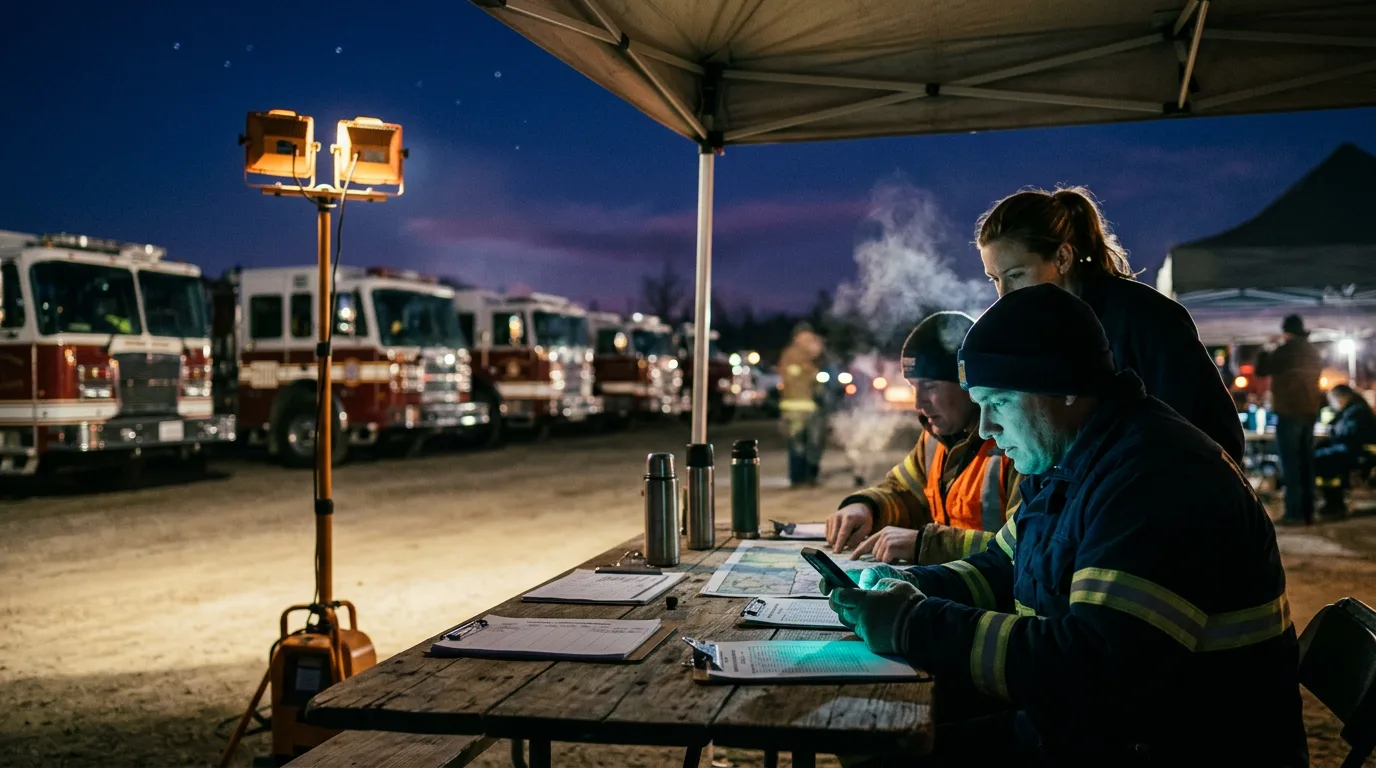
At 0600 on day two, a mutual aid strike team pulls into Staging from two counties over. They've driven four hours. Their ICS training is current. They've never seen your incident, your map, your radio plan, or the Division Supervisor they're about to work for.
The ICS check-in takes three minutes. The 211 gets filled out and the team goes into the pool. What they know when they leave Staging for the first assignment depends on whoever was standing at the table.
Check-In Is a Training Window, Not Just a Form
The ICS 211 does three jobs. It records when each resource arrived and where it first reported, it supports the next assignment, and it starts the record you'll need at demobilization. We've written about it as the start of your cost and evidence trail.
It's also the one moment you can count on having every arriving responder in front of you. Self-dispatch and freelancing are what FEMA's own resource management training names as the threats to accountability. Check-in is where you close that gap. A responder who leaves check-in without a clear picture is the one most likely to end up freelancing.
Six Things to Confirm Before the First Assignment
None of this is new doctrine. It's what experienced supervisors confirm by habit. Writing it down means it gets confirmed even when the person at the table isn't that experienced.
1. Who they report to. One name, one position, one way to reach them. Unity of command depends on the responder knowing the answer before they leave Staging.
2. Their assignment. The ICS 204 is the contract: the work assignment, the special instructions, and the resources assigned with them. A responder who has read their own 204 doesn't need to ask their supervisor for it later.
3. Their team. Who else is on the assignment, who's leading it, and who is a trainee. On a mixed mutual aid team, this can be the first time these people have worked together.
4. The IAP pages that matter to them. The full IAP is for the Planning Section. An arriving responder needs three parts: the communications plan (ICS 205), the medical plan (ICS 206), and the safety message (ICS 208). That's the information they need if something goes wrong in the first hour.
5. How to raise a problem. A hazard, an injury, or a resource shortfall should go up the chain, not around it. Tell them the escalation path explicitly. People who don't know it tend to call whoever they know at home base.
6. Where they're going on the map. Division boundaries, drop points, Staging, and the route in. Someone from two counties over doesn't know your local landmarks, so they need the map itself.
Why Ten Minutes, and Why on the Phone
As we covered last week, procedural ICS knowledge starts fading within weeks of training. A responder whose last refresher was in the spring needs a reminder of specifics: this assignment, this team, this radio plan. A full review of ICS doctrine at the check-in table won't help them, and they don't have time for it.
That reminder has to be short enough to finish before the first briefing and specific enough to the incident to be worth their attention. Ten minutes is a realistic limit. Most check-in lines don't allow more.
It also has to reach the responder. As we noted in the IAP distribution post, Staging usually has a few printed IAPs for a lot of people. Everyone has a phone, but Staging doesn't always have coverage, so the briefing has to work offline.
Make It the Same Every Time
The briefing will only be consistent if it's a fixed script and not left to whoever is running check-in. Write the six items down. Run every arrival through them, whether it's a strike team or a single specialist. Treat a responder as briefed when all six are confirmed, not when they've reached the table.
One way to make that consistent is to put it on the responder's phone. When the 204, the IAP, and the map are on every checked-in responder's phone and work offline, the six items become something the responder can read for themselves while waiting in line. Whatever tool you use, the point is that the briefing is the same for every arrival and doesn't depend on who's at the table.
The responder who arrived at 0600 should be able to tell you their supervisor's name, their division, and their radio channel before they climb back into the truck. If they can't, they weren't briefed.
See how NIMS Logic puts the assignment, the IAP, and the map in every responder's pocket, online or off. Explore mobile for the field.
Ready to modernize your incident management?
See how NIMS Logic transforms emergency management from an administrative burden into operational advantage with real-time visibility and automated workflows.
Schedule a DemoPresident & Co-Founder
Martin brings over 40 years of emergency management experience to NIMS Logic, including service as a Type 1 Incident Commander. His field expertise in ICS operations, multi-agency coordination, and FEMA cost recovery drives the platform's operational design.
Continue Reading
Two Incidents a Year: Why Responder Skills Fade Between Activations
November 4, 2026
The research on skill decay is blunt: unused skills fade within months, and the procedural work of ICS fades fastest. What that means for responder training.
Documentation Isn't Paperwork. It's Accountability.
July 21, 2026
FEMA already defined accountability as six operational principles. Every one of them is an unverifiable claim without a record. The money argument is secondary.
Course Completion Isn't Qualification: The Gap Between NIMS Training and Being Ready
October 28, 2026
NIMS compliance counts course certificates. NQS qualification takes task books, evaluated performance, and review. Here is how agencies can close the gap.