
Demobilization Starts at Check-In: The Planning Gap Nobody Staffs
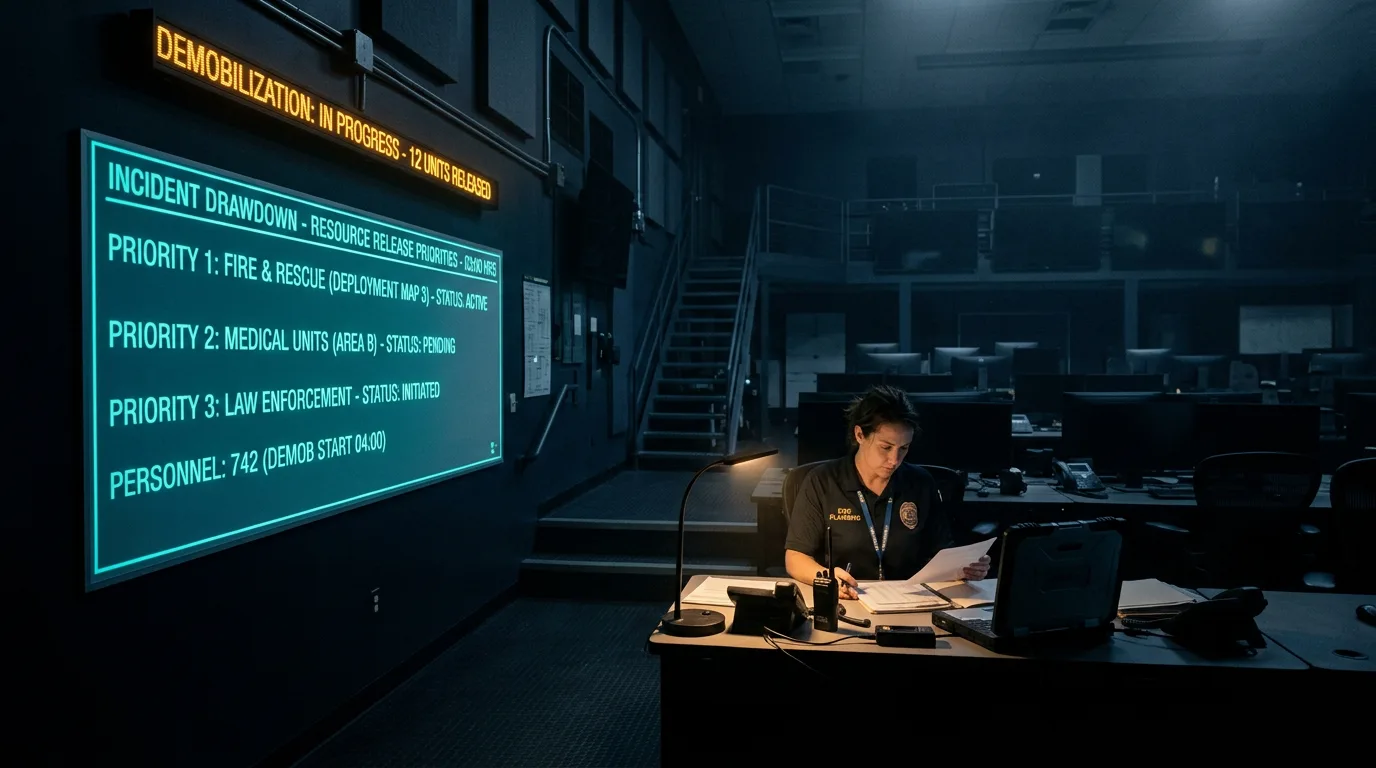
Every incident has a moment when the tempo breaks. The threat is contained, the operational picture stabilizes, and the room that was running three deep at every position starts to thin out. That is the moment demobilization planning is supposed to be at full stride.
It almost never is. On most incidents demobilization is treated as a closeout task — something the Planning Section gets to after the work is done. So the release happens ad hoc: a chief calls his people home, a mutual aid company decides its own departure time, equipment leaves on the back of a truck nobody logged.
This is the gap. It is not that agencies forget the ICS 221. It is that the plan the 221 is supposed to execute against was never built.
Demobilization Is a Day-One Function
Doctrine is unambiguous on this point, and it is worth stating plainly because so much practice contradicts it. Demobilization Unit staff begin their work early in the incident — creating rosters of personnel and resources, and obtaining any missing information as check-in proceeds.
Read that again. The demob function is working the check-in line. It is not waiting downstream for the incident to wind down; it is building its roster off the ICS 211 in real time, because the information it needs is easiest to capture at the moment a resource arrives and hardest to reconstruct at the moment it leaves.
An agency that stands up demobilization on day six of a nine-day incident has already lost the five days of roster accuracy that make an orderly release possible.
Release Priorities Are a Command Decision, Not a Logistics Detail
A demobilization plan has five sections: General Information, Responsibilities, Release Priorities, Release Procedures, and Travel Information. Two of those carry the weight.
Release Priorities are agreed by Command and General Staff. This is a genuine command decision with operational consequences — which capability do you give up first, and what risk are you accepting when you do? Release the wrong resource in the wrong order and you have de-staffed a function that the next operational period still needs.
Release Procedures should carry the most detail: identification of the resource, authorization to release it, and notification to that resource of its impending demob status. Each of those is a handoff, and each handoff is where accountability drops on paper.
Here is the structural problem. Both decisions require the incident's coordination capacity — the Planning Section running at full function, the General Staff in the room, the resource picture current. And both are due at exactly the point in the incident when that capacity is being drawn down. The organization is shrinking precisely when demob needs it at full size.
That is why demobilization fails. Not neglect. Sequencing.
The Plan Is Dynamic, Which Paper Cannot Absorb
On any significant incident, demobilization plans are dynamic and get updated frequently. Release priorities shift when the weather turns. A resource scheduled out on Thursday extends through the weekend. A mutual aid strike team's home agency recalls it early.
Every one of those changes ripples through the roster, the travel schedule, and the release sequence. On paper, that means a document that is stale the moment it is printed and a Demobilization Unit Leader reconciling a whiteboard against a clipboard against a phone.
When resource status is tracked continuously — every check-in, every assignment, every status change captured by operational period as operations unfold — the demob roster is not a document somebody maintains. It is a live view of the incident that already exists. The Demobilization Unit Leader stops rebuilding the picture and starts working the release. This is the practical argument for digital ICS forms that share one data model: the 211 that recorded the arrival and the 221 that records the release are reading from the same record, not two piles of paper that have to be married up afterward.
What Good Looks Like
You can audit your own demobilization posture with three questions:
- Was a Demobilization Unit Leader assigned before the incident peaked? If demob got assigned during the drawdown, the roster work started too late.
- Do written release priorities exist, approved by Command? If release order is being decided resource-by-resource in the moment, it is not a priority scheme — it is a queue.
- Can you produce, right now, a current list of every resource on the incident and its expected release date? If that takes more than a few minutes to assemble, the demob plan is not actually operational.
None of this is exotic. It is the Planning Section doing what the Planning Section is chartered to do — thinking one operational period ahead of the incident. Demobilization is simply the last place that discipline gets applied, and the first place it gets dropped.
The downstream cost is real: a resource released without a documented close leaves a cost record you cannot bound, which is where reimbursement claims quietly fail. But the reason to plan demobilization early is not the audit. It is that releasing people and equipment from a hazardous environment is an operation, and operations get planned.
See how NIMS Logic tracks resources across the full incident lifecycle — from check-in through demobilization — so the release picture is current before you need it. Explore the platform.
Ready to modernize your incident management?
See how NIMS Logic transforms emergency management from an administrative burden into operational advantage with real-time visibility and automated workflows.
Schedule a DemoPresident & Co-Founder
Martin brings over 40 years of emergency management experience to NIMS Logic, including service as a Type 1 Incident Commander. His field expertise in ICS operations, multi-agency coordination, and FEMA cost recovery drives the platform's operational design.
Continue Reading

Resource Lifecycle Tracking: From Check-In to Demobilization (Where Your FEMA Evidence Is Actually Built)
June 19, 2026
A resource is only as reimbursable as its paper trail. Walk the ICS 211 → 204 → 214 → 221 lifecycle — and see where paper breaks the chain auditors follow.

The ICS Org Chart and the EOC Org Chart Are Not the Same Chart
August 16, 2026
Both are NIMS. But NIMS names three EOC structures, and the same section titles do different work on either side. Here is what actually differs.

Documentation Isn't Paperwork. It's Accountability.
July 21, 2026
FEMA already defined accountability as six operational principles. Every one of them is an unverifiable claim without a record. The money argument is secondary.