
Two Incidents a Year: Why Responder Skills Fade Between Activations
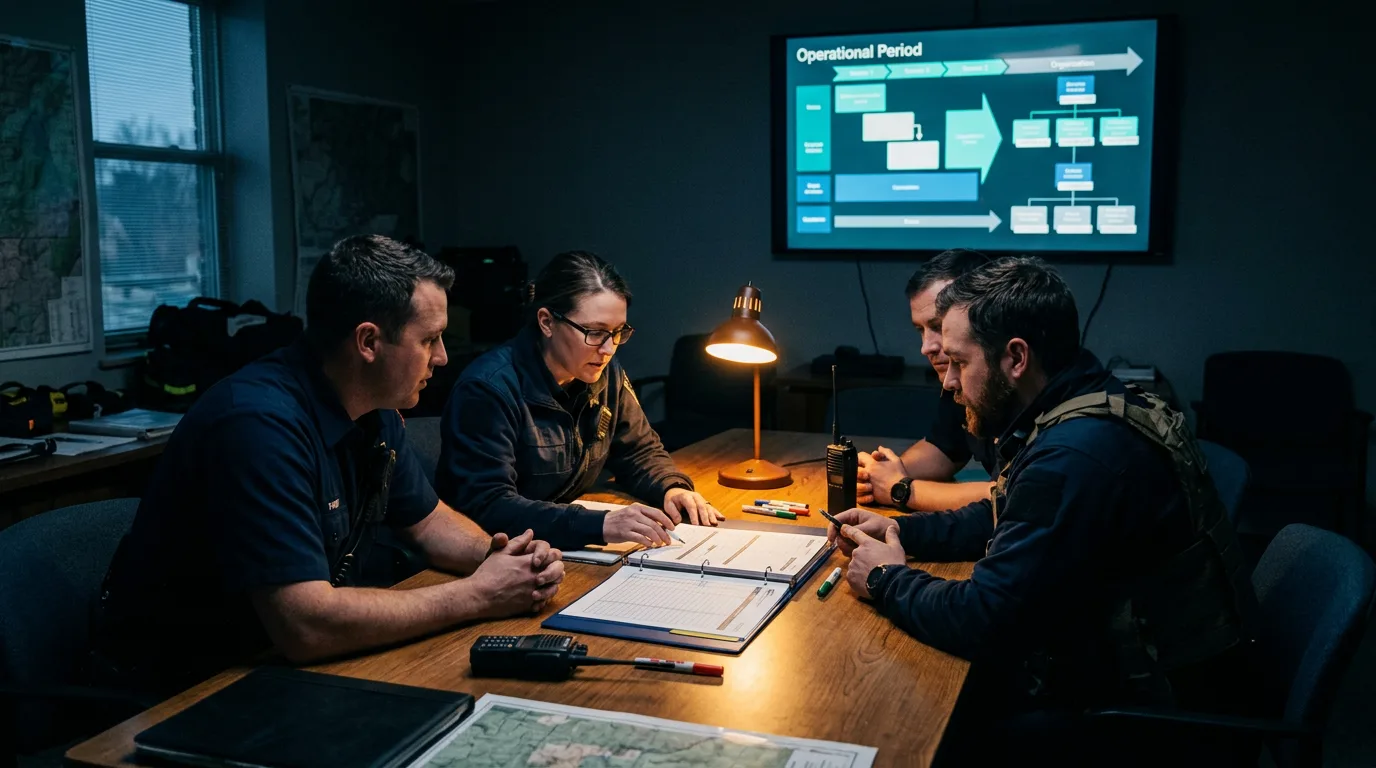
Take a deputy emergency manager who ran two incidents last year: a spring flood and an ice storm in December. They finished their refresher in March. The next activation could come in November.
For eight months, nothing they learned for incident management got used. The research on what happens to unused skills is consistent, and the timing doesn't work in that deputy's favor.
What the Research Says About Skills You Don't Use
Three findings sum it up.
Skill loss with nonuse is substantial and gets worse with time. In 1998, Arthur, Bennett, Stanush, and McNelly published a meta-analysis in Human Performance covering 189 data points from 53 studies. Loss was close to zero immediately after training and reached a large effect (d = −1.4) after more than a year without use.
The decline starts within weeks. A 2020 review in the Journal of Military and Veterans' Health found that across several emergency-care disciplines, skill fade occurs "from around eight weeks" with "peak decline at six months."
Re-certifying more often isn't the fix. A 2011 study in the Scandinavian Journal of Trauma, Resuscitation and Emergency Medicine observed 257 people paid to act as workplace first responders. Many of their skills deteriorated within the first 90 days. The authors' conclusion is the useful part: increasing how often people re-certify "is not necessarily the most obvious choice." What they recommended was regular, high-frequency refreshing, as often as every 90 days.
Six months is a typical gap between activations for a county program. In this research, that's about where the decline peaks.
ICS Work Is the Kind That Fades Fastest
The meta-analysis also identified which skills fade fastest. Physical, natural, and speed-based tasks held up better. Cognitive, artificial, and accuracy-based tasks lost more.
That describes most of what ICS asks of people. Form numbers, block layouts, resource typing, and reporting chains are artificial in that sense: they're conventions, and nothing about them is intuitive. Filling out an ICS 214 that will survive a FEMA review is accuracy work. Running the planning meeting on schedule is cognitive work. These aren't skills like hose handling, which practice locks into muscle memory. They're the skills that fade first.
So the person who could brief a 204 without notes in March may struggle with the same briefing in November. That isn't a lack of effort. It's what happens to that kind of skill when it goes unused.
Knowing Isn't Doing
The 2011 study found one more thing worth keeping in mind. The responders' knowledge didn't decline significantly over time. They still passed the written test. Their performance in the scenario did decline.
That's the same gap described in our last post, from the individual's side. Course completion records knowledge. The incident tests performance. A knowledge check run six months after the course will tell you everything is fine.
You usually find out on the incident. The after-action review records that activity logs were incomplete, the resource order went to the wrong desk, and the first operational period's IAP was late. Some of that traces back to skills that had faded since the last training.
Train on the Interval, Not the Calendar
Annual refreshers are scheduled by the calendar. Skill decay follows how long it's been since someone last did the task. A few changes line training up with that:
Shorten the refreshers and space them out. A 10-minute walkthrough of the 214 every quarter does more than a four-hour block once a year. The 2011 study's 90-day suggestion is a reasonable place to start.
Practice on the actual form and screen. Artificial tasks are tied to their specific conventions, so refresh people on the exact form, the exact sequence, and the exact system they'll use on the incident. Generic ICS review doesn't refresh those details.
Refresh at activation. Before someone takes an assignment, a short review of the two or three tasks that position needs most catches what has faded since their last training. Just-in-time ICS modules already exist for this, and practitioners treat the format as suited to focused tasks, not broad proficiency. That limitation is fine for this purpose.
Let the after-action review set the next refresher. If the 214s were thin, the next quarterly refresher covers 214s. The AAR shows which skills faded, so use it to decide what to train next.
None of this replaces the courses or the task books. It keeps people from losing what they learned in the months between activations. For incident management teams that see a handful of incidents a year, that's when most of the loss happens.
See how NIMS Logic builds ICS workflows around the forms and Operational Periods responders already know. Explore the platform.
Ready to modernize your incident management?
See how NIMS Logic transforms emergency management from an administrative burden into operational advantage with real-time visibility and automated workflows.
Schedule a DemoPresident & Co-Founder
Martin brings over 40 years of emergency management experience to NIMS Logic, including service as a Type 1 Incident Commander. His field expertise in ICS operations, multi-agency coordination, and FEMA cost recovery drives the platform's operational design.
Continue Reading
The First Ten Minutes After Check-In: Training the Responder Who Just Arrived
November 11, 2026
Every responder passes through ICS check-in. Six things an arriving responder must know before the first assignment, and how to brief them in ten minutes.
Course Completion Isn't Qualification: The Gap Between NIMS Training and Being Ready
October 28, 2026
NIMS compliance counts course certificates. NQS qualification takes task books, evaluated performance, and review. Here is how agencies can close the gap.

The ICS Org Chart and the EOC Org Chart Are Not the Same Chart
August 16, 2026
Both are NIMS. But NIMS names three EOC structures, and the same section titles do different work on either side. Here is what actually differs.