
Documentation Isn't Paperwork. It's Accountability.
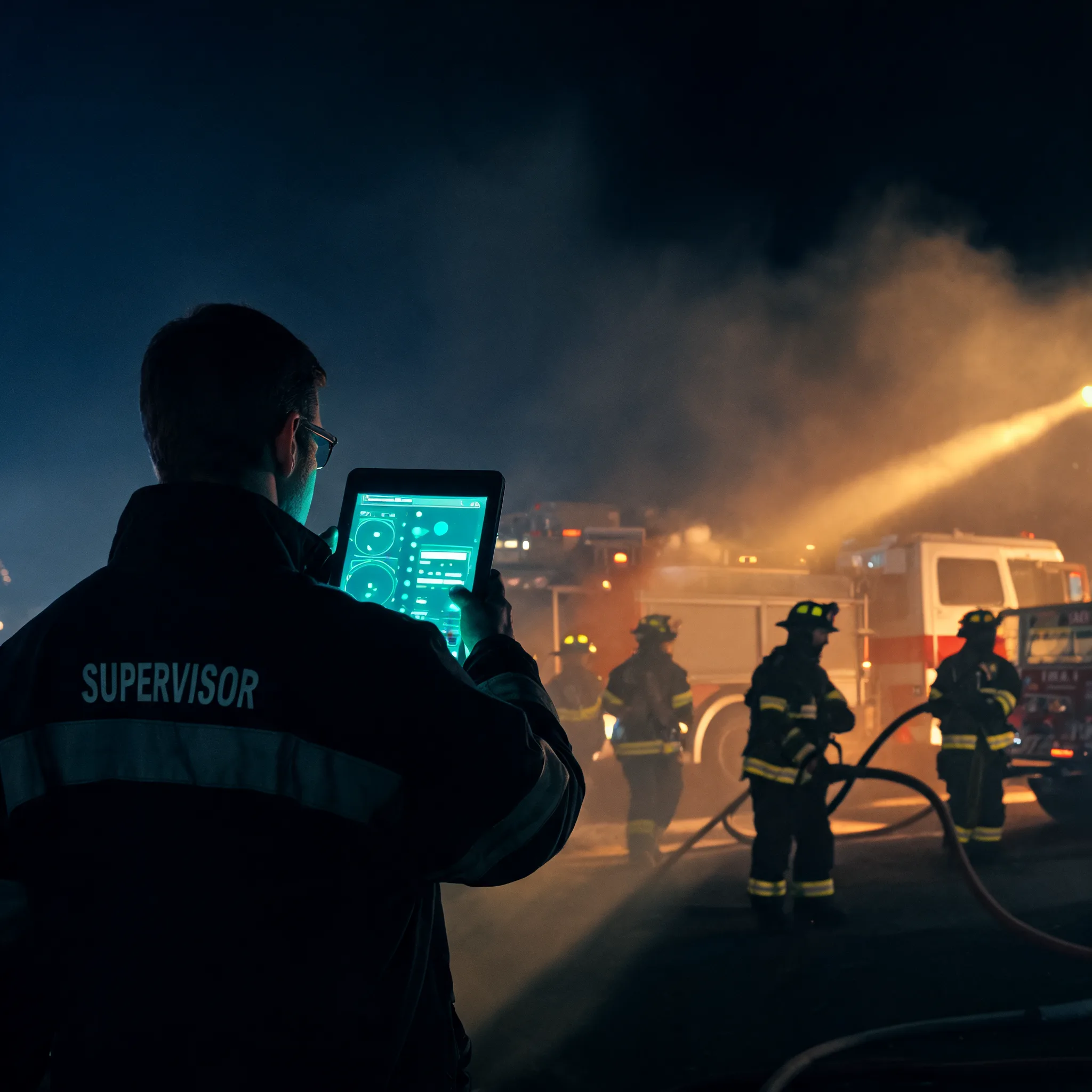
Every argument for incident documentation eventually turns into a money argument. Capture the ICS 214 so the project worksheet holds up. Track equipment hours so the reimbursement survives audit. Those arguments are true, and this post is not going to make them.
Set the money aside entirely. Assume a jurisdiction that will never file a Public Assistance claim, on an incident that will never be declared. The case for documentation is exactly as strong, and it is a case about accountability — which is a word FEMA already defined, precisely, in doctrine most of us have had on the shelf since 2017.
FEMA Already Wrote Down What Accountability Means
Accountability is one of the fourteen NIMS Management Characteristics in the National Incident Management System, Third Edition. It is not a general aspiration toward being responsible. The doctrine enumerates it: incident personnel should adhere to principles of accountability including check-in/check-out, incident action planning, unity of command, personal responsibility, span of control, and resource tracking.
Read that list as an auditor would, and something becomes obvious. Five of those six are claims about the state of the incident. Claims are either supported by a record or they are assertions.
An agency that says "we ran ICS" and cannot produce the artifacts has not run ICS. It has performed ICS.
Six Principles, Six Records
Check-in/check-out. The ICS 211 is where accountability begins, and check-out is where it ends — the half everyone skips. A resource that checked in and never checked out is, formally, still on your incident. If you cannot produce a check-in record, you cannot answer the only question that matters at 0200 when conditions change: who is out there right now? Not who was assigned this morning. Who is out there.
Incident action planning. An operational period without a documented plan is a period with no shared objectives. Everyone is working hard and nobody can demonstrate they were working on the same thing. The IAP is the artifact that makes command intent inspectable — which is why an IAP that never reaches the field is functionally an IAP that was never written.
Unity of command. Every responder reports to one supervisor. That principle is trivially easy to state and remarkably easy to violate on a growing incident, especially when mutual aid arrives and a division supervisor starts directly tasking a crew that belongs to someone else. Without a current ICS 203/204 structure, nobody can see the violation. With one, double assignment is visible the moment it happens.
Personal responsibility. Responders are accountable for their own actions. That is only meaningful if their actions were recorded. A responder who did everything right on an incident with no documentation has no way to demonstrate it — which is the part rarely said out loud. Undocumented incidents fail the responder as much as the agency.
Manageable span of control. Doctrine puts the target at three to seven, optimally five, and notes span of control matters most where safety and accountability are the priority. Span of control is a number. It is computed from the org structure. If the structure lives on a whiteboard that stopped being accurate at the second operational period, nobody is computing anything — the Safety Officer is estimating, and estimating a supervisor's ratio during a fast-moving incident is exactly the moment it silently reaches 1:12.
Resource tracking. Status, location, assignment, supervisor. Continuously, not at demob. A T-card rack tracks this well when one person stands in front of it. It tracks nothing at all for the Operations Section Chief standing half a mile away, or for the demobilization planner trying to release resources in an order that doesn't strand a crew.
The Roll Call Test
Here is the test that ends the paperwork argument in most agencies.
Mid-incident, unannounced, ask the Incident Commander for a complete accounting of personnel on the incident: name, unit, current assignment, supervisor, last contact time. Give them five minutes.
Agencies running paper find out how long five minutes is. The answer is usually assembled by radio, from supervisors who are themselves reconstructing, while the incident continues without their attention. On a wildland fire with an entrapment, or a structural collapse with a secondary hazard, that same five minutes is the interval in which a personnel accountability report either exists or doesn't.
Nobody in that scenario is thinking about a project worksheet.
What You Lose Before You Lose Money
An agency without an operational record loses things in a specific order, and the reimbursement is last.
First it loses real-time answers — who is where, who is unaccounted for, which division has been asking for resources for two periods without a fill. Then it loses transfer of command, because a briefing package assembled from memory omits exactly what the incoming IC doesn't know to ask about. Then it loses the ability to learn, because there is nothing to review afterward. Then, eventually, months later, it loses the money.
Agencies tend to notice the loss in reverse order. The finance director notices the denial. Nobody files an incident report titled "we could not have produced a PAR."
This is why documentation belongs inside operations rather than beside it. When the ICS data model is the system of record — check-in creating the resource, the assignment binding it to a supervisor and an objective, the activity log accruing against the operational period — accountability stops being something you assert after the incident and becomes something the incident continuously demonstrates. Platforms built this way, including NIMS Logic, produce the FEMA package as a downstream artifact. But the reason to run them is the 0200 question, not the project worksheet.
The Standard Is Doctrinal, Not Financial
If your agency's answer to "why document?" is reimbursement, you have accepted a standard set by a grant program rather than by the job. Most incidents your agency runs this year will never be federally declared. The accountability obligation applies to all of them.
The test is not whether FEMA will pay. The test is whether, at any moment during an active incident, you can say who is working for you, who they answer to, and what you asked them to do.
Ready to modernize your incident management?
See how NIMS Logic transforms emergency management from an administrative burden into operational advantage with real-time visibility and automated workflows.
Schedule a DemoPresident & Co-Founder
Martin brings over 40 years of emergency management experience to NIMS Logic, including service as a Type 1 Incident Commander. His field expertise in ICS operations, multi-agency coordination, and FEMA cost recovery drives the platform's operational design.
Continue Reading

The ICS Org Chart and the EOC Org Chart Are Not the Same Chart
August 16, 2026
Both are NIMS. But NIMS names three EOC structures, and the same section titles do different work on either side. Here is what actually differs.
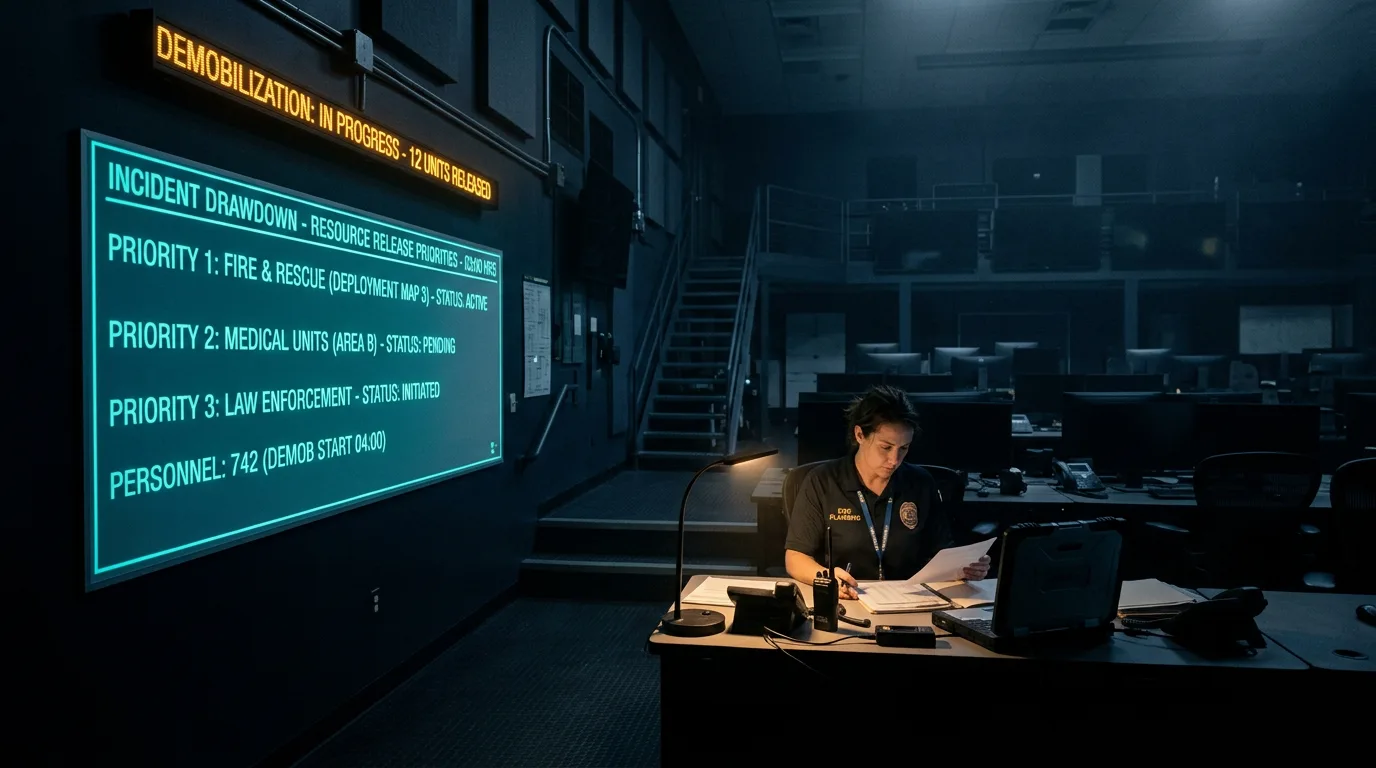
Demobilization Starts at Check-In: The Planning Gap Nobody Staffs
August 28, 2026
Demobilization is a planning function that begins on day one — not a closeout task. Why release priorities have to be set while the incident is still busy.

Resource Lifecycle Tracking: From Check-In to Demobilization (Where Your FEMA Evidence Is Actually Built)
June 19, 2026
A resource is only as reimbursable as its paper trail. Walk the ICS 211 → 204 → 214 → 221 lifecycle — and see where paper breaks the chain auditors follow.