
Training the Field Leader: What Bosses, Strike Team Leaders, and Division Supervisors Actually Need
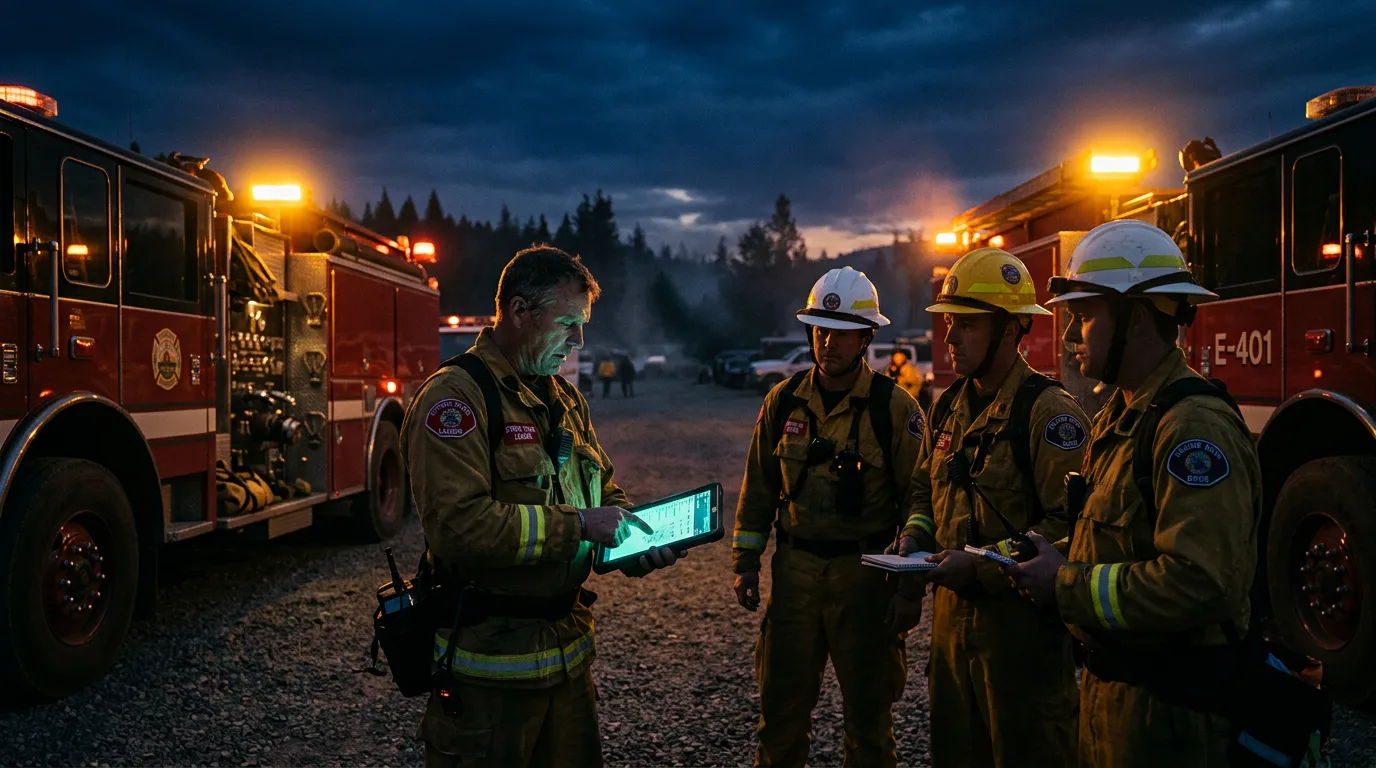
The strike team that came through check-in last week has one person standing in front of it: the Strike Team Leader. Behind that person are five Engine Bosses. Ahead of them is a Division Supervisor holding the ICS 204.
All three hold their ICS courses, and they're doing three different jobs. Most field-leader training treats them as one job at three sizes. That's where the gaps come from.
Three Titles, Three Jobs
NIMS gives each level of the field organization its own title, and the titles aren't decoration. In the doctrine's table of ICS titles, a single resource is run by a Boss, a strike team or task force by a Leader, and a division or group by a Supervisor. The glossary defines a Leader as responsible for "a unit, strike team, resource team, or task force," and a Supervisor as responsible for "a division or group."
Each step up changes what the person directs:
- The Boss directs people doing the work: an engine crew, a hand crew, a patrol team.
- The Leader directs resources. Five engines, not twenty-odd firefighters.
- The Supervisor directs a part of the incident. A geographic division or a functional group, with whatever teams and single resources Operations assigns to it.
The Boss: Do the Work, Write It Down
Engine Boss, Crew Boss, the sergeant of a patrol team. The Boss owns the head count, the safety of their people, and the task in front of them. Most agencies train this level well, because it's the job most responders learned first.
The gap is the paperwork, and it isn't really paperwork. The Boss keeps the ICS 214 for the resource. That log is the only real-time record of what the resource did and when. As we covered in the ICS 214 and force account labor walkthrough, it's also what FEMA will look for later. A Boss who skips the 214 leaves a gap nobody can reconstruct afterward.
Train this level on two things: briefing their people from the 204, and keeping a 214 someone else could read.
The Leader: Direct Resources, Not People
The Leader exists to protect someone else's span of control. NIMS says it directly: "Consolidating single resources into task forces and strike teams reduces supervisors' spans of control." The Division Supervisor sees one Strike Team Leader instead of five Engine Bosses.
That's a hard step for a strong Boss. The best Engine Boss on the department is used to being on the line. As a Leader, their job is to split the assignment into tasks for each Boss, keep the team on common communications, and watch the whole team instead of one engine. NIMS calls one supervisor to five subordinates the "optimal span of control" and adds that the ratio "is a guideline." A Leader who's still doing a Boss's job has a span of one.
Task Force Leaders have the harder version. The NIMS flood example pairs a dump truck, a backhoe, and a five-person shovel crew under one leader. Running that safely means knowing what each kind of resource can and can't do, not just the one you came up on.
The Supervisor: Own the 204
A division exists, in the NIMS glossary's words, "when the number of resources exceeds the manageable span of control of the Section Chief." The Division or Group Supervisor is the reason the Operations Section Chief can manage the incident at all.
The Supervisor's document is the ICS 204. It lists the work assignment, the resources assigned, the special instructions, and the communications for that division or group. A good Supervisor treats it as a contract with Operations. They brief it to every Leader and Boss, manage the boundary with the adjacent division, and report back up the chain. NIMS's unity of command rule, that each person "reports to and takes direction from only one person," only holds if the Supervisor keeps it.
The Supervisor also feeds the next Operational Period. What their division got done, what it still needs, and which resources are wearing out all feed the planning for tomorrow's 204.
Train the Step, Not Just the Seat
As we covered two weeks ago, knowing a procedure isn't the same as doing it under load. In the field, the doing breaks down at the step up. A newly promoted Leader keeps doing the Boss's job, and a new Supervisor manages one team closely and loses track of the rest of the division.
Three changes close that gap:
Train each seat on its own document. Bosses on the 214, Leaders on breaking a 204 assignment into tasks, Supervisors on briefing the 204 and reporting progress against it.
Drill the handoff. In a tabletop, have a Supervisor brief a Leader, and the Leader brief three Bosses. Then ask the Bosses what their assignment is. What drops out between the 204 and the crew is what you train next.
Put trainees in the seat on real incidents. Put a trainee in the position with a qualified person beside them. That's where the qualification record actually gets built, and it's where we go next in this series: how task books get signed on real incidents.
Ready to modernize your incident management?
See how NIMS Logic transforms emergency management from an administrative burden into operational advantage with real-time visibility and automated workflows.
Schedule a DemoPresident & Co-Founder
Martin brings over 40 years of emergency management experience to NIMS Logic, including service as a Type 1 Incident Commander. His field expertise in ICS operations, multi-agency coordination, and FEMA cost recovery drives the platform's operational design.
Continue Reading
Task Books Get Signed on Real Incidents: Qualification Evidence as a Byproduct of Operations
November 25, 2026
Position task books get signed on real incidents. What the evaluator records, what the review board asks for, and how to capture it before the incident ends.
The First Ten Minutes After Check-In: Training the Responder Who Just Arrived
November 11, 2026
Every responder passes through ICS check-in. Six things an arriving responder must know before the first assignment, and how to brief them in ten minutes.
Two Incidents a Year: Why Responder Skills Fade Between Activations
November 4, 2026
The research on skill decay is blunt: unused skills fade within months, and the procedural work of ICS fades fastest. What that means for responder training.