
FEMA 214s, T-Cards, and the Forms You Can't Reconstruct After the Fact
It is day 22 of a federally declared disaster. Finance is asking you what FEMA needs. You are at your desk searching "FEMA Public Assistance documentation checklist," "how to fill out ICS 214," and "what is force account labor documentation."
The search itself is the diagnosis. Every form on that checklist is a contemporaneous record — meaning its evidentiary value depends on it having been captured during the work, not after. By the time an agency administrator is looking up the form list, the window for the cleanest version of half of those documents has already closed.
This is not a paperwork problem. It is a temporal one.
The Forms FEMA Actually Wants to See
The FEMA Public Assistance Program and Policy Guide (PAPPG) is explicit about supporting documentation for Category B emergency protective measures and other reimbursable categories. The package generally includes:
- ICS 211 (Incident Check-In List) — proof a resource arrived, when, and from where
- ICS 214 (Activity Log) — the "FEMA 214" — what each resource did during each operational period, in their own words, signed by their supervisor
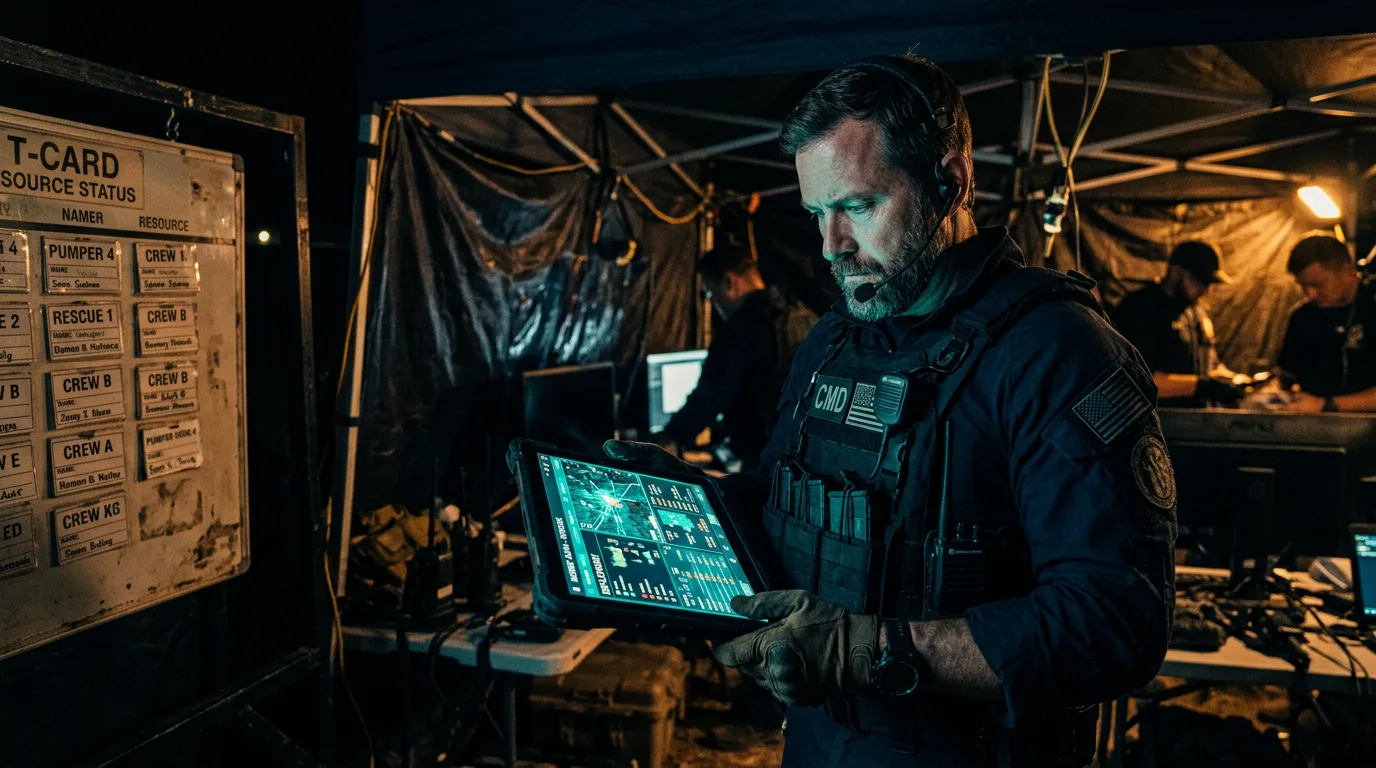
- ICS 219 (Resource Status Cards) — the T-cards — the live status of every resource: available, assigned, out-of-service
- ICS 204 (Assignment List) — the mission each resource was given, organized by Operational Period and supervisor
- ICS 213RR (Resource Request) — the audit trail of why a resource was ordered
- OF-286 (Emergency Equipment Use Invoice) — for force account equipment cost capture
- FEMA Form 90-91 (Project Worksheet) — the claim itself, which references everything above
Of these, the ICS 214 and the T-card system (ICS 219) are the two that auditors trust most as evidence — and the two that are most often invented after the fact.
Why the FEMA 214 and the T-Card Cannot Be Backfilled
A 214 is a moment-by-moment activity log. Its value to FEMA is not the words on the page. It is that the words were written at the time the work was happening, by the person doing the work or their immediate supervisor, and signed off at the end of the shift. When that record gets reconstructed two weeks later from a pocket notebook, a memory, or worse, a colleague's memory, what you produce is a narrative, not evidence. Auditors can tell the difference. They look for round numbers, repeated activity descriptions across resources, vague language ("performed emergency operations"), missing or improbable timestamps, and supervisor signatures that all appear to be in the same handwriting.
The T-card problem is more brutal. ICS 219 cards exist to track resource status in real time at the Resources Unit. When a crew moves from available to assigned to out-of-service, that status transition is supposed to be captured on the card as it happens. After demob, you have a stack of cards that show the final state — not when each transition occurred, who authorized it, or how long the resource was committed to a given assignment. A FEMA reviewer looking at a force account claim wants the timeline. A box of T-cards does not carry the timeline. It carries the last frame.
This is why agencies that ran a paper-and-T-card incident often produce reimbursement packages where the outputs exist but the evidence does not. The ICS 214 backbone post covers why the 214 is the load-bearing document of every Project Worksheet. What the T-card adds is the fact that even the resource status data — the simplest, most obvious part of an incident — disappears if it is not captured live.
What Reconstruction Actually Costs You — Beyond the Lost Reimbursement
The headline cost of bad documentation is denied or reduced reimbursement. The hidden cost is the agency administrator hours spent on RFI cycles. A single Project Worksheet RFI — FEMA asking the applicant to substantiate or clarify a claim — typically pulls the emergency manager, the finance director, and often the agency administrator or county manager into multiple rounds of records review, supervisor interviews, and follow-up correspondence that can stretch over weeks.
For mid-sized jurisdictions, an RFI cycle complicated by reconstructed documentation can absorb 40 to 80 executive-level hours. Multiply that across the average PA package — large incidents routinely generate dozens of PWs, and large PWs each generate one or more RFIs — and the documented financial loss is dwarfed by the opportunity cost of senior staff time pulled away from running the agency.
That is the part that does not show up in the FEMA reimbursement spreadsheet but absolutely shows up in the next budget cycle, the next election cycle, or the next time the agency is asked to lead a complex response.
The Only Fix That Holds Up in Audit: Capture in the Field, in Real Time
You cannot add timestamps to a memory. You cannot retrofit a supervisor signature onto a backfilled log. You cannot reconstruct status transitions on a T-card after the rack has been broken down. The only way the documentation FEMA wants actually exists is if it was generated as a byproduct of the work itself.
That is a mobile problem. Specifically, mobile ICS capture in the field — every check-in, every assignment, every status change, every activity log entry timestamped, geolocated, attributed to a named user, and tied structurally to the Operational Period and the assignment it supports. When the planning section publishes the IAP, the assignments flow to the resources. When the resource works the assignment, the 214 entries build themselves. When the resource's status changes, the digital equivalent of the T-card moves automatically and the transition is logged. By the time the Operational Period ends, the record for that period is complete — without anyone going back to "fill out the paperwork."
That standard is what platforms like NIMS Logic are built around. The full resource lifecycle from check-in to demobilization is captured as it happens, organized by Operational Period the way PAPPG-aligned PA documentation is reviewed, and exported in a structured package. For agency administrators who carry the cost-recovery and audit-defensibility risk, the question shifts from "what forms do we need to assemble?" to "what is already in the package?" — and the answer is different.
If your finance director just asked you what FEMA needs, the honest answer for this incident is to do the cleanest reconstruction you can, document its limitations, and submit. The answer for the next incident is to make sure the question never has to be asked.
See how real-time ICS capture changes the documentation conversation →
Ready to modernize your incident management?
See how NIMS Logic transforms emergency management from an administrative burden into operational advantage with real-time visibility and automated workflows.
Schedule a DemoPresident & Co-Founder
Martin brings over 40 years of emergency management experience to NIMS Logic, including service as a Type 1 Incident Commander. His field expertise in ICS operations, multi-agency coordination, and FEMA cost recovery drives the platform's operational design.
Continue Reading
The ICS 214 Is the Backbone of Your FEMA Project Worksheet. Are You Treating It That Way?
April 8, 2026
FEMA auditors scrutinize PW documentation harder than ever. The ICS 214 activity log — often called the FEMA 214 — is your primary evidence for cost recovery.
The Hidden Cost of Failed FEMA Documentation: Eligible Costs Lost to Inadequate Paperwork
March 20, 2026
Agencies lose FEMA Public Assistance dollars not because costs are ineligible, but because documentation fails to prove eligibility. Learn how to close the gap.

Mutual Aid Billing: From Handshake to Reimbursement
June 25, 2026
Mutual aid feels like the work is done when help arrives. FEMA only pays if you billed for it. Walk the path from handshake to reimbursement — and the record it takes.