
ICS 214 to FEMA PA Reimbursement: Why Your Activity Logs Are Leaving Money on the Table
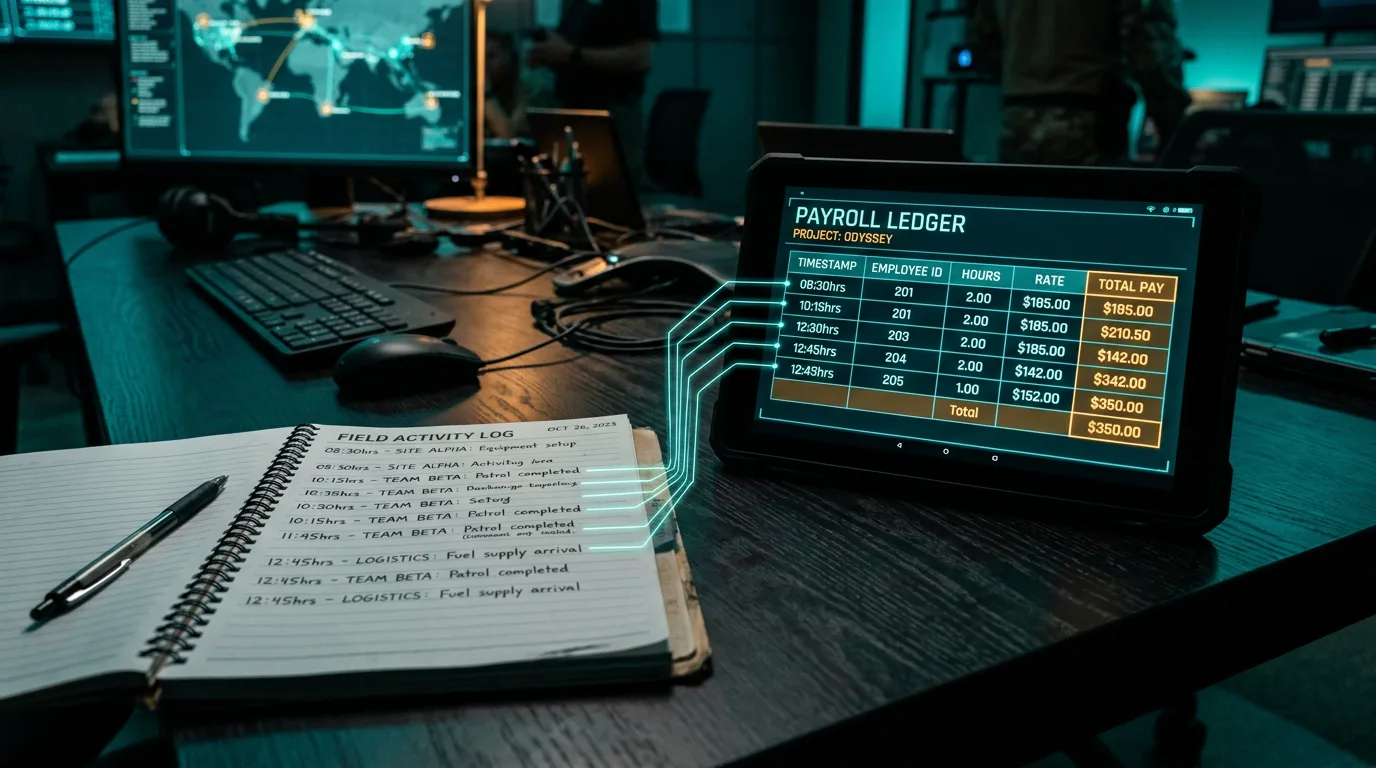
Agencies that keep ICS 214 activity logs during an incident are already ahead of most. But having the logs is not the same as getting paid for them. Between the 214 and the Category B claim are several handoffs, and eligible costs fall out at each one.
We have written about why the 214 is the backbone of the Project Worksheet and why it cannot be reconstructed after the fact. This post is the mechanical part: how an activity log entry becomes a reimbursed dollar, and where the money leaks out along the way.
The Pipeline, Step by Step
For Category B emergency protective measures performed with your own staff and equipment, the path from the field to a claim runs through five records.
- ICS 211, Check-In. Establishes that a person or piece of equipment arrived, when, and from which agency.
- ICS 204, Assignment List. Ties that resource to a specific assignment in a specific operational period. This is where eligible emergency work is defined.
- ICS 214, Activity Log. Records what the resource actually did, and when, signed by the supervisor at the end of the shift.
- Payroll and timesheets. Translate those hours into straight time and overtime at actual pay rates, governed by your written labor policy.
- FEMA summary records. The Force Account Labor Summary Record and its equipment counterpart roll everything up by employee and by piece of equipment for the project.
Each step depends on the one before it. A 214 entry that cannot be tied to a 204 assignment is hard to defend as eligible work. A timesheet that disagrees with the 214 creates a discrepancy the reviewer has to resolve, usually in FEMA's favor. Most lost money comes from gaps between these records, not from any one form being missing.
Leak 1: The Labor Policy You Didn't Write Down
Before any hour gets reimbursed, FEMA looks at your pay rules. Eligibility for overtime, premium pay, and compensatory time is determined by your pre-disaster written labor policy, provided it:
- does not make payment contingent on federal funding,
- is applied uniformly whether or not there is a presidential declaration, and
- has set, non-discretionary criteria for when each pay type applies.
"Pre-disaster" means published and in effect before the incident start date in the declaration. Appeals decisions have rejected policies adopted afterward, even ones meant to formalize existing practice. Rate increases adopted after the disaster have been denied while the pre-disaster rates were approved.
If your policy pays overtime to exempt employees during declared emergencies only when FEMA reimburses it, you have written yourself out of eligibility. Review the policy now, before the next incident, not during the claim.
Leak 2: Budgeted Versus Unbudgeted Staff
For emergency work in Categories A and B, the general rule is that budgeted employees are eligible for overtime only. Their straight time is already in your budget. Unbudgeted employees, such as temporary hires or staff brought on specifically for the response, can be eligible for both straight time and overtime.
Agencies lose money in both directions. Some claim straight time for budgeted staff, which gets disallowed and invites scrutiny of the rest of the package. Many more never separate out their unbudgeted personnel at all, and leave eligible straight time unclaimed.
This distinction has to be visible on the 211 and carried through payroll. If the check-in record does not show who was hired for the response, the claim cannot show it either.
Leak 3: Dropping Straight Time From the Log
This one costs the most and is the least understood.
Because a budgeted employee's straight time is not eligible, crews and supervisors often stop recording it. The 214 only shows the overtime hours, since those are "the ones FEMA pays." But the equipment that employee operated during straight time is eligible. The operator's labor record is the evidence for those equipment hours.
Florida county guidance says it directly: regular hours are used to verify the equipment time claimed. Drop straight-time hours from the activity log and the equipment claim for those hours is left with nothing to support it.
The rule for field documentation is simple. Log every hour worked on the incident, regardless of pay type. Eligibility gets sorted out in the claim, not in the field.
Leak 4: One Fringe Rate for Everything
Force account labor is reimbursed at actual pay rates plus actual fringe benefits, calculated as a percentage of the hourly rate. The percentage for overtime is usually different from the percentage for straight time, because some benefits, such as health insurance and certain leave accruals, do not grow with extra hours worked.
Applying your straight-time fringe rate to overtime hours overstates the claim, and the reviewer will catch it. The opposite mistake, claiming overtime with no fringe or at a lower rate than you actually pay, leaves money on the table. Calculate both rates from payroll, document how you did it, and apply each to the right hours.
Leak 5: 214 Entries That Don't Describe Eligible Work
A 214 that says "emergency operations, 0700–1900" proves someone was busy. It does not show they were performing an eligible emergency protective measure. Reviewers read activity descriptions, and generic entries repeated across a dozen employees look reconstructed, not contemporaneous.
Good entries name the activity, the location, and the equipment: "Sandbagging at Elm St. low-water crossing, operated loader #14." That entry connects directly to the 204 assignment, the equipment record, and the eligible work category. It also takes the supervisor no more time to write than "emergency operations."
Where the Pipeline Gets Rebuilt by Hand
Look at the five leaks together and a pattern appears. Every one of them happens at a handoff between records kept in different places by different people: field logs on paper, check-in on a clipboard, payroll in a finance system, summary records in a spreadsheet built months later. Every handoff is a chance for an hour, a rate, or a classification to drop out.
When the 211, 204, and 214 share one record, so that check-in, assignment, and activity are captured against the same resource in each operational period, most of the pipeline already exists by the time finance needs it. The summary records become a report, not a reconstruction project. That is the practical meaning of documentation as a byproduct of operations, and it is why digital ICS forms matter more to finance than to anyone else on the incident.
The same discipline applies to resources you borrow. Mutual aid billing runs through the same pipeline, with another agency's records added at each step.
A Pre-Season Checklist
- Confirm your written labor policy meets all three tests, and that its adoption date is documented.
- Make sure check-in records flag unbudgeted and response-specific personnel.
- Train supervisors to log all hours, including straight time, with specific activity descriptions.
- Calculate separate straight-time and overtime fringe rates from current payroll.
- Do a test run: take one past incident and trace five employees from 211 to summary record. Wherever the trace breaks is where your next claim will lose money.
See how NIMS Logic connects check-in, assignment, and activity records so your Category B documentation exists before the claim starts. See how cost recovery works.
Ready to modernize your incident management?
See how NIMS Logic transforms emergency management from an administrative burden into operational advantage with real-time visibility and automated workflows.
Schedule a DemoPresident & Co-Founder
Martin brings over 40 years of emergency management experience to NIMS Logic, including service as a Type 1 Incident Commander. His field expertise in ICS operations, multi-agency coordination, and FEMA cost recovery drives the platform's operational design.
Continue Reading
FEMA Snow Assistance: Documenting the 48 Hours That Count
October 21, 2026
FEMA snow assistance covers one continuous 48-hour window, and only with record or near-record snowfall. What qualifies and how to document it before winter.

The Hidden Cost of Failed FEMA Documentation: Eligible Costs Lost to Inadequate Paperwork
March 20, 2026
Agencies lose FEMA Public Assistance dollars not because costs are ineligible, but because documentation fails to prove eligibility. Learn how to close the gap.

Mutual Aid Billing: From Handshake to Reimbursement
June 25, 2026
Mutual aid feels like the work is done when help arrives. FEMA only pays if you billed for it. Walk the path from handshake to reimbursement — and the record it takes.