
Your Counties Are Running Incidents You Can't See
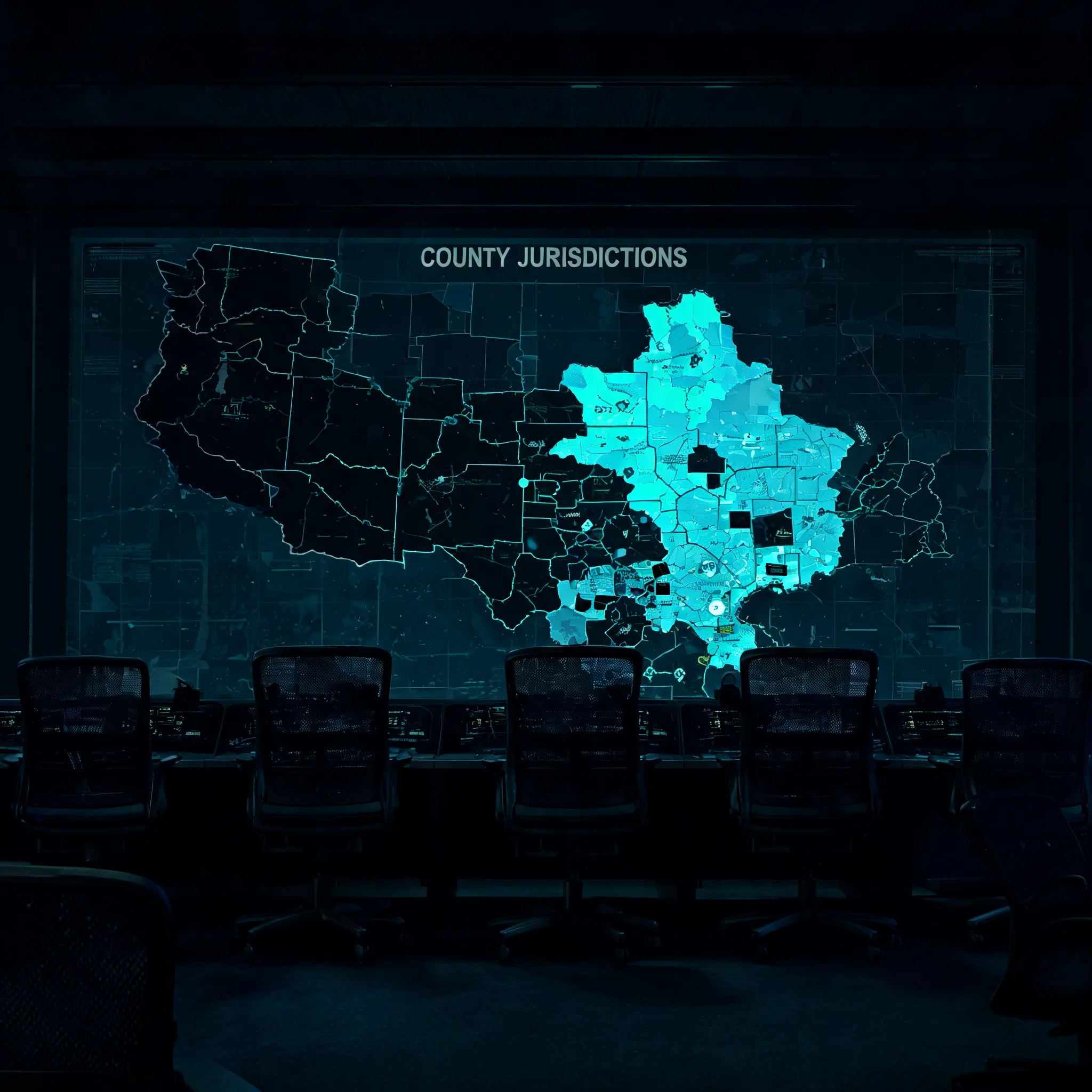
A county activates for a flash flood on a Tuesday afternoon. Public works runs equipment for eleven hours. Two fire districts respond under a mutual aid agreement. A city street department drops road closure barricades and pulls them back three days later.
The state emergency management office finds out about most of it in a situation report. It finds out what the operation actually cost — and whether any of it is defensible — eight months later, when a project worksheet lands with gaps in it.
That is the visibility problem sitting under nearly every state EM office right now, and no amount of dashboard investment at the state EOC fixes it. The issue is not that the state can't see the incident. The issue is that the state can't see the record of the incident, because the record was never created.
The Recipient of Record Has No Record
Under FEMA Public Assistance, the state is the recipient. Counties, municipalities, special districts, and eligible private nonprofits are subrecipients. The state processes subgrants under 2 CFR Part 200 and 44 CFR Part 206 Subpart G, provides technical assistance, and submits what FEMA needs to award.
That structure has an uncomfortable implication most states have never had to confront directly: the state carries administrative responsibility for the quality of evidence produced by jurisdictions it does not command.
Your county EM directors do not work for you. You do not set their staffing. You cannot make a public works foreman fill out an activity log. And yet when the documentation behind a $2.3 million debris project doesn't hold up, the finding attaches to the grant — and the grant is yours.
Most states manage this the only way the tooling allows: retrospectively. Quarterly reports. Invoice review. Desk monitoring at closeout. By the time any of that produces a signal, the operational period where the evidence should have been captured ended two seasons ago.
What Monitoring Actually Requires
2 CFR 200.332 sets out what a pass-through entity owes on every subaward. Evaluate each subrecipient's risk of noncompliance, considering prior experience with similar awards and the results of previous audits. Monitor during the period of performance. Verify single audit compliance. Follow up on findings.
Read the verb tense. Monitoring during the period of performance is not a closeout activity. For a disaster subaward, the period of performance includes the days the incident is actually running.
The 2024 Uniform Guidance revision raised the single audit threshold from $750,000 to $1 million for fiscal years beginning on or after October 1, 2024. That sounds like relief. In practice it means a meaningful tier of small jurisdictions now falls below the audit floor entirely — jurisdictions the state is still responsible for monitoring, but that no longer generate an independent audit product for the state to lean on. The risk didn't go away. The external check on it did.
The Gap Is Timing, Not Effort
State EM offices are not failing to look. They are looking at the wrong artifacts at the wrong time.
Financial monitoring reviews what a jurisdiction spent. Operational documentation proves the spend was eligible — that this crew, on this equipment, performed this eligible work, at this location, during this declared period, under an assignment that traces to an incident objective. Those are two different data sets, and only one of them can be reconstructed from an invoice.
By the time a county submits force account labor summaries, the underlying question — was there ever an ICS 214 behind this? — has a fixed answer. If the answer is no, no amount of state technical assistance changes it. As we've written before, the 214 and the T-card only count if they were captured live.
The federal direction of travel makes this sharper, not softer. Section 313 puts project-level PA data on a public dashboard. The proposals to restructure PA into a fast state-managed disbursement would move money to states before the justification exists. Both assume the state can produce project-level fidelity on demand. Neither assumes the state gets eight months to assemble it.
What Mid-Incident Visibility Looks Like
The useful state-level question during an activation is not "what is happening." It's "which of my jurisdictions is currently generating a defensible record, and which one is going to cost me a finding."
That is answerable, and it doesn't require the state to take command of anything. It requires four signals rolled up across every activated jurisdiction:
Is an incident actually open? Not a phone call and a sitrep — a declared incident with a start time, objectives, and operational periods. Jurisdictions running "informally" are the ones that produce nothing.
Are resources checking in? ICS 211 check-in is the origin point of every downstream cost record. A jurisdiction with running equipment and zero check-ins has no chain of custody for a single billable hour.
Are activity logs accruing per operational period? An operational period that closes with no 214 entries is a period that will be reconstructed from memory or written off.
Is force account labor tied to an assignment? Hours without an ICS 204 assignment behind them are the specific thing that fails audit — not because the work didn't happen, but because nothing connects the person to the eligible scope.
None of those four require the state to direct local operations. They require the state to see whether local operations are producing evidence while there is still time to pick up the phone. That is the difference between monitoring and archaeology.
This is the case for building the state layer on the ICS data model rather than on top of a grants management system. Grants systems are built to track money after it moves. The evidence that justifies the money is generated in the field, in operational period increments, by people who will never log into a grants portal. Platforms like NIMS Logic close that distance by making the state roll-up a byproduct of the operations each jurisdiction is already running — so cost recovery starts with a record instead of a reconstruction.
Ask the Question Before the Next Activation
Pick your last three county-level activations. For each one, ask how long it would take to answer: how many resources checked in, who supervised them, and what eligible work did they perform in which operational period.
If the honest answer is "we'd have to call the county and hope," you have found the gap. It is not a paperwork problem and it does not belong to the counties alone. The state is the recipient of record, and right now the record does not exist.
Ready to modernize your incident management?
See how NIMS Logic transforms emergency management from an administrative burden into operational advantage with real-time visibility and automated workflows.
Schedule a DemoEditorial Team
The NIMS Logic team combines decades of emergency management field experience with modern software engineering to build the incident management platform the industry has needed.