
FAIR Explained: How FEMA's Proposed Individual Assistance Replacement Would Work
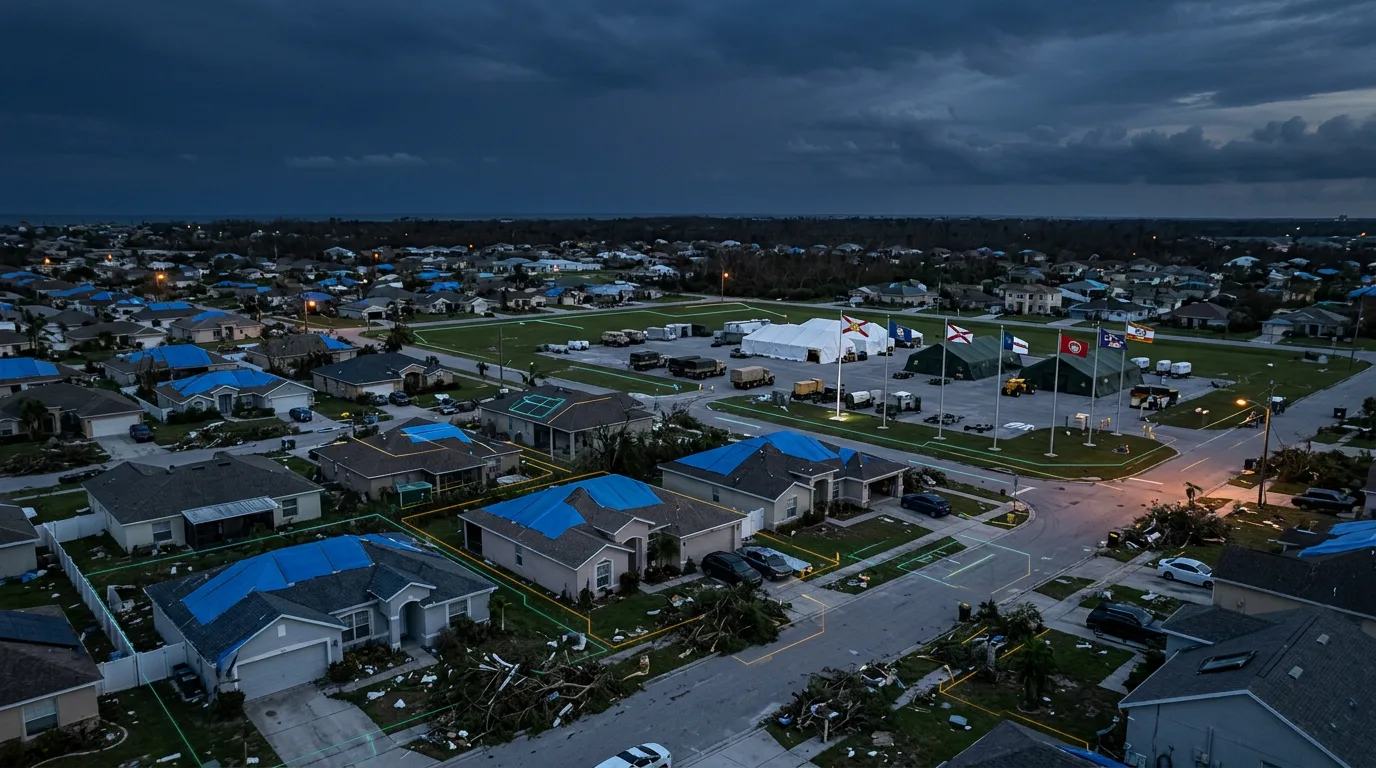
One Direct Payment, Fifteen Categories Retired
The FEMA Review Council's May 7 final report proposes eliminating the Individual Assistance program in its current form and replacing it with the Framework for Accessible Individual Relief — FAIR. It is the third of the report's three new program vehicles, alongside RAPID for Public Assistance and R3P for hazard mitigation, and it is the one with the simplest mechanical story and the deepest operational implications for state and local human-services agencies.
The mechanics are drawn from the Council's final report. The framing problem is one every IA coordinator has lived: the current program presents survivors with more than fifteen separate assistance categories — Housing Assistance, Other Needs Assistance, Critical Needs Assistance, Transportation Assistance, Childcare Assistance, Medical and Dental Assistance, Funeral Assistance, and so on — each with its own eligibility test, its own documentation requirement, and its own queue. FAIR collapses that structure into a single direct payment for a single qualifying condition.
The Eligibility Threshold Tightens
Under IA today, a survivor whose home suffered minor damage and a survivor whose home is uninhabitable can both touch the program — through different categories, different caps, different inspection workflows. FAIR narrows the federal trigger to one condition: the survivor's primary residence is uninhabitable as a result of the declared disaster.
That single threshold is the load-bearing change. It moves minor-damage cases, partial-displacement cases, and incidental-need cases out of the federal program entirely. The Council's framing is that those cases belong with insurance, with SBA disaster loans, with HUD programs, and with state and local human-services systems. FAIR is reserved for the cohort that the prior IA structure routinely failed to serve at speed: people whose homes are gone.
The Homeowner Formula
For homeowners whose primary residence meets the uninhabitable threshold, FAIR provides a direct payment capped at 15% of the assessed value of the property, up to a hard ceiling of $150,000. That is the entire federal contribution. There is no separate Housing Assistance award, no Other Needs Assistance overlay, no chase down the fifteen-plus category list to assemble a survivor's package.
The 15% / $150K formula is doing two things at once. It scales with property value — so a $300,000 home and a $1,000,000 home produce different payments — and it caps that scaling so the program does not become a high-end housing subsidy. The Council's intent is parity at the bottom of the curve and triage at the top. For state IA coordinators, the operational consequence is that the program's payment ceiling becomes predictable per survivor in a way today's category stack is not.
The Renter Formula
Renters whose primary residence is uninhabitable receive three months of rent at the HUD Fair Market Rate for the affected geography, with an option for an additional three months. The maximum federal exposure per renter household is six months of HUD FMR.
This is the part of the program that quietly resolves one of IA's most persistent friction points — the gap between a survivor's actual displacement timeline and the federal program's willingness to fund it. FAIR sets the cadence at three plus three, indexes the payment to a published HUD number, and stops. Beyond month six, the survivor's housing path is insurance, HUD's longer-term programs, SBA loans, or state and local systems. FEMA exits.
What Shifts to State, Tribal, and Territorial Governments
The Council's most consequential structural move on the individual side is not the payment formula. It is the transfer of evacuation and emergency sheltering responsibility to state, tribal, and territorial governments. Today FEMA underwrites a meaningful share of mass-care operations through IA and through the Disaster Relief Fund. Under FAIR, that responsibility is explicitly STT.
For state IA coordinators and county human-services directors, this is the line item that changes the planning math. Sheltering capacity, congregate-care contracting, non-congregate hotel arrangements, transportation to and from shelters, accessibility compliance — these become state and local expenditures with state and local procurement timelines and state and local audit trails. The federal supplemental funding still flows, but the program-management responsibility is no longer a federal-state shared workload. It is a state workload that the federal layer supports.
The Optional State-Managed Program
FAIR includes a provision that mirrors the state-managed posture of RAPID and R3P: states may elect to administer the program directly, taking the federal allocation and running survivor intake, eligibility determination, payment, and reconciliation themselves. States that decline that election receive a federally-administered FAIR program in their jurisdiction.
The election is not free. A state that administers FAIR takes on the documentation and audit obligations that come with the federal allocation — survivor records, eligibility evidence, payment ledgers, accessibility compliance, and a reconciliation audit that lands on the state's auditor or comptroller. The states that have already built mature IA-coordination capacity — joint federal-state Disaster Recovery Centers staffed at scale, integrated case-management systems, established sheltering contracts — are the ones positioned to take the election and convert it into faster survivor payments.
The Implementation Window
FAIR, like RAPID and R3P, requires Congressional action. The bipartisan FEMA Act of 2025 (H.R. 4669) is the most likely legislative vehicle, and the Council's own phased rollout assumes two to three years. None of the payment caps, the renter formulas, or the evacuation-responsibility transfer take effect on their own.
What does not require legislation is the operational posture states will need on day one. The FAIR design assumes states already maintain the sheltering capacity, the survivor-intake infrastructure, the audit-ready documentation systems, and the human-services coordination that the federally-led IA model has historically supplied. The states that build that capacity now will run FAIR cleanly. The states that wait for the law to pass will discover the gap in the middle of the next major disaster.
Ready to modernize your incident management?
See how NIMS Logic transforms emergency management from an administrative burden into operational advantage with real-time visibility and automated workflows.
Schedule a DemoEditorial Team
The NIMS Logic team combines decades of emergency management field experience with modern software engineering to build the incident management platform the industry has needed.
Continue Reading

FEMA Review Council Final Report: What State and Local Emergency Managers Need to Know
May 8, 2026
The FEMA Review Council's May 7 final report proposes RAPID, R3P, and FAIR — replacing PA, HMGP, and IA. Here is what state and local EMs need to know.

The State Layer: Why Emergency Management Software Has to Change When the Federal Role Contracts
May 25, 2026
RAPID, R3P, FAIR, and Section 313 collectively make state EM offices the disaster prime contractor. The software stack has to follow.

RAPID Explained: How FEMA's Proposed Public Assistance Replacement Actually Works
May 11, 2026
RAPID would replace FEMA Public Assistance with a parametric trigger, 30-day direct funding to states, and a two-phase audit. Here is how the mechanics work.